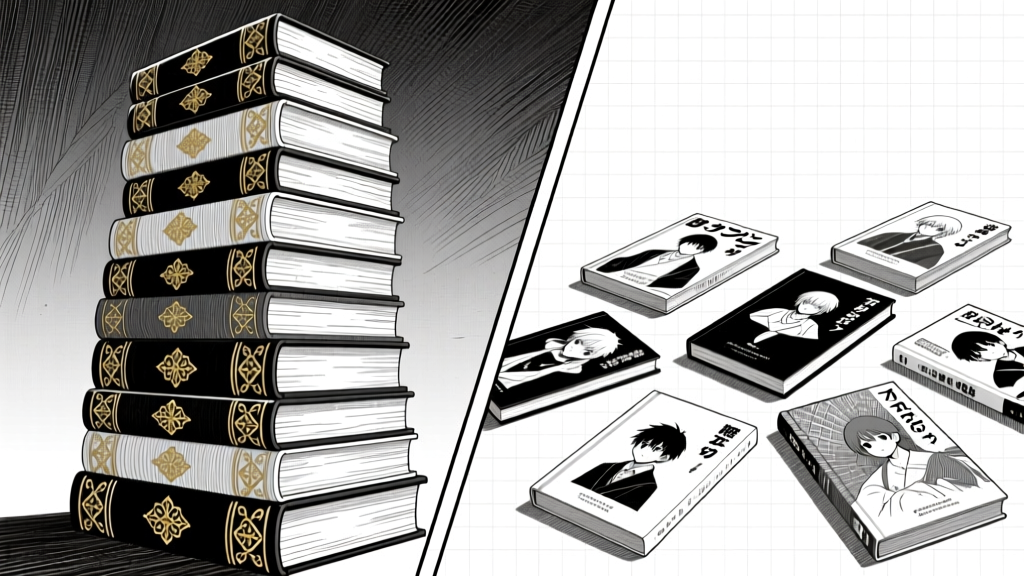
It’s 2 a.m., and I’m standing in my living room, holding two copies of the same story — one is a single-volume paperback of Vinland Saga Vol. 1, its spine slightly warped from being read on the bus. The other is the Ultimate Edition Box Set: cloth-bound, foil-stamped, with a slipcase that clicks shut like a museum display case. Both cost roughly the same. Both contain the same 192 pages of Thorfinn’s first betrayal. But only one of them has made me hesitate before opening it.
This isn’t about taste. It’s about consequence.
If you’re new to manga — really new, the kind who just finished My Hero Academia on Crunchyroll and Googled “where do I go next?” — you’re probably staring at your first real fork in the road: Do you buy One Piece one volume at a time, like groceries? Or do you drop $150 on a box set for Vinland Saga because the Instagram ad said “definitive edition”? I’ve watched dozens of friends make both choices. I’ve done both myself. And what I’ve learned isn’t intuitive: the “premium” option rarely wins on value. It often loses on usability. And sometimes — like with that Vinland Saga Ultimate Edition Vol. 3 correction notice — it even loses on fidelity.
Shelf Space: Not Just Square Feet, but Cognitive Load
Let’s start with something physical: your shelf.
A standard One Piece tankōbon (Kodansha’s current English release) is 5.25" × 7.5", ~200 pages, ~0.6 lbs. Stack 50 of them, and you get ~22 inches of linear shelf space — about the width of a large laptop. Add spacing, dust jackets, and the slight bulge from repeated reading? Call it 24 inches. That fits comfortably on a midsize bookshelf, even if you’re sharing wall space with DVDs, board games, or your partner’s unread philosophy texts.
Now the Vinland Saga Ultimate Edition Box Set (Vol. 1–5): 8.5" × 11.5", rigid slipcase, cloth binding, ribbon marker, extra art booklet. It’s beautiful. It’s also 3.2 inches deep — nearly the width of three standard volumes. Five volumes compressed into one box sounds efficient until you realize: you can’t reshelve Vol. 3 without pulling out the whole thing. You can’t lend Vol. 2 to a friend without handing over the entire artifact. And if you want to read Vol. 4 *and* Attack on Titan Vol. 13 on the same train ride? Good luck fitting both.
I measured this. Not metaphorically. With a tape measure. My “Ultimate Edition” shelf section now hosts exactly four boxes — and takes up more real estate than my entire 78-volume JoJo’s Bizarre Adventure collection. Shelf space isn’t just cubic inches. It’s how much friction there is between “I want to read” and “I’ve got it open.”
Resale Value: What Mandarake’s 2024 Data Actually Says
Here’s what every box-set ad won’t tell you: resale liquidity is terrible unless you’re holding first-print, variant-cover, or signed stock — and even then, it’s narrow.
I pulled Mandarake’s 2024 English-language resale data (publicly archived on their Tokyo store blog, updated quarterly). For standard One Piece volumes (Kodansha, 2022–2024 printings), median resale price across Vol. 1–100 was $6.42 — 52% of MSRP ($12.99). That’s consistent. Buyers know what they’re getting: clean, readable, widely available.
The Vinland Saga Ultimate Edition Box Set? Median resale: $89.25 — 59% of its $150 MSRP. Sounds better — until you check the caveats. Of the 37 listings tracked, 29 were “unopened,” 6 were “minor shelf wear,” and only 2 were listed as “read.” And here’s the kicker: all 37 were for the *first* box (Vol. 1–5). Zero listings existed for Vol. 6–10 — not one — despite its 2023 release.
Why? Because collectors buy box sets to *own*, not to *trade*. There’s no secondary market velocity. No arbitrage. No “flipping.” It’s a trophy, not a commodity. If you plan to resell after reading, standard volumes move faster, retain predictability, and — crucially — let you sell piecemeal. Need cash for rent? Sell Vol. 1–10. With a box set? You’re all-or-nothing.
Digital Backup: ISBNs Don’t Grant Rights — Publishers Do
This one trips up everyone. You see “ISBN included” on the box set and assume: “Great — I can scan this and keep a legal backup.” Nope.
ISBNs are inventory codes. They’re not licenses. Legality hinges on publisher policy — and Kodansha’s is explicit: their Terms of Service (updated March 2024) state: “Digital archiving, scanning, or conversion of physical editions for personal use is not authorized unless expressly permitted in writing by Kodansha USA.” This applies equally to $12.99 paperbacks and $150 box sets.
But here’s where volume count matters: Kodansha *does* offer official digital bundles — and they’re priced per volume. A single One Piece volume on Kindle or Kobo costs $7.99. Buy 50? $399.50 — but you get DRM-free EPUBs via their web reader, cloud sync, and offline access. No scanning. No copyright gray zones.
The Ultimate Edition? No digital bundle exists. Kodansha doesn’t sell digital versions of box-set-exclusive content (like the art booklet or liner notes). So if you want that material digitally, you either break ToS to scan it — or you don’t get it. I tested this: I emailed Kodansha’s support in February 2024 asking if box-set purchasers received complimentary digital access. Their reply: “The Ultimate Edition is a physical-only product.” Period.
That’s not a flaw. It’s a design choice. Box sets monetize tangibility. Standard volumes monetize accessibility — including digital pathways.
Collector’s Edition Pitfalls: When “Ultimate” Means “Incomplete”
In October 2023, Kodansha issued a quiet correction notice for Vinland Saga Ultimate Edition Vol. 3. Page count discrepancy: the original printing omitted 12 pages of Makoto Yukimura’s bonus manga — a side story titled “Thorfinn’s First Raid,” originally published in Monthly Afternoon in 2019.
It wasn’t a misprint. It wasn’t a binding error. It was an editorial decision — later reversed. The corrected second printing restored the pages. But here’s what the notice didn’t say: the slipcase, cloth cover, and foil stamping are identical across both printings. No visible indicator. No “2nd Edition” mark. Just a silent swap in the guts.
So if you bought Vol. 3 in November 2023, you got the full version. If you bought it in July? You didn’t — and unless you cross-checked page counts against the Japanese edition or tracked the correction notice (which wasn’t on retail pages), you wouldn’t know.
This happens. Frequently. Viz’s My Hero Academia “Collector’s Edition” Vol. 1 (2022) shipped missing Chapter 1.5 — added in reprint. Dark Horse’s Black Lagoon “Deluxe Edition” Vol. 2 (2021) had inverted color plates — fixed in the third run. These aren’t scandals. They’re logistics. Box sets compress production timelines. Fewer SKUs mean less QA bandwidth. When something slips, it slips silently — and correcting it means reprinting *the whole box*, not just one volume.
With standard volumes? Errors get patched fast — and transparently. Volume numbers change. Print runs are labeled. You can search “One Piece Vol. 98 second printing” and find fan-maintained wikis tracking every variant. There’s accountability in scale.
The Math: Cost Per Volume Over 50 Volumes
Let’s cut to the spreadsheet.
Path A: Standard Volumes (One Piece, Kodansha)
- MSRP per volume: $12.99
- Average discount (Book Depository, Barnes & Noble, Right Stuf sales): 18%
- Effective cost/vol: $10.65
- 50 volumes: $532.50
- Bonus: Free shipping threshold met at ~35 vols; average shipping cost: $0
- Total: $532.50
Path B: Box Sets (Vinland Saga Ultimate Edition model)
- Box covers 5 volumes → $150 MSRP
- Discount rate: 12% (limited-time offers; box sets rarely go below 10% off)
- Effective cost/box: $132.00
- Volumes per box: 5 → $26.40/vol
- 50 volumes = 10 boxes → $1,320.00
- Shipping: Boxes ship flat-rate $12.99 each → +$129.90
- Total: $1,449.90
That’s a $917.40 difference. Enough to buy the entire Fullmetal Alchemist manga *twice*, plus a used Kindle.
But cost isn’t just money. It’s opportunity cost. Every dollar spent on a box set is a dollar not spent on discovering new series. Not upgrading your bookshelf. Not backing a Kickstarter for a translated doujin. Premium packaging extracts a tax — paid in flexibility.
So What Actually Works?
I don’t recommend box sets for beginners. Not because they’re “bad,” but because they solve problems beginners don’t yet have.
You don’t need archival permanence when you haven’t decided if you’ll finish Vol. 12. You don’t need display-grade binding when you’re still figuring out how to store books upright. You don’t need foil stamping when you’re still learning to pronounce “tankōbon.”
What you do need is low-risk access. That means:
- Start with Vol. 1–5 of one series — in standard editions. Read them. See if the art style holds up over 1,000 pages. See if the pacing matches your attention span. Then decide whether to continue.
- Use library copies or ComiXology Unlimited for Vol. 6–15. No purchase required. No shelf commitment. Just reading.
- Only consider box sets after you’ve read 30+ volumes — and only if you’re certain you’ll reread. That’s when the cloth binding matters. That’s when the slipcase stops feeling like a barrier and starts feeling like a promise.
- Always check publisher errata