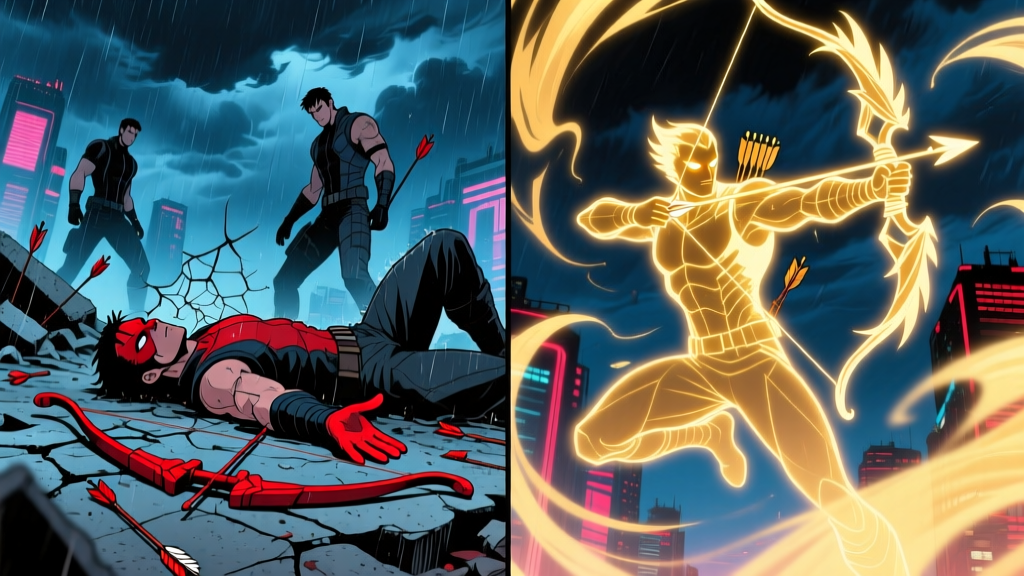
In the long history of Marvel's mightiest heroes, few creative shake-ups hit as hard as Brian Michael Bendis's New Avengers launch in late 2004. The book didn't just relaunch a franchise—it detonated forty years of continuity, killed a founding Avenger, and rebuilt the team from the wreckage into something leaner, darker, and far more unpredictable. At the center of that wreckage was Clint Barton, the original Hawkeye, whose death in Avengers #503 became one of the most talked-about moments in modern superhero comics.
This guide walks through the entire arc: the Avengers Disassembled event that tore everything down, the street-level New Avengers that rose from the rubble, Hawkeye's shocking end, his long road back, and the essential issues every reader needs to experience this era properly.
The Setup: Why Marvel Blew Up the Avengers
By 2004, the Avengers title had been running for over four decades and sales had been sliding for years. The team had cycled through dozens of roster changes, multiple relaunches, and a revolving door of writers who each tried to recapture the magic of the Stan Lee/Jack Kirby and Roger Stern/John Byrne eras. Nothing stuck. The book was creatively stagnant, and Marvel's editorial team—led by Editor-in-Chief Joe Quesada—decided the only way forward was to burn it all down.
Enter Brian Michael Bendis. Fresh off a critically acclaimed run on Daredevil and the massive success of Ultimate Spider-Man, Bendis was Marvel's hottest writer. His pitch was simple but radical: destroy the Avengers as readers knew them, kill off characters who had been fixtures for decades, and rebuild the team as a smaller, grittier, more morally complex unit that operated without government sanction or public approval.
The vehicle for this destruction was Avengers Disassembled, a storyline that ran through Avengers #500–503 (cover-dated August through November 2004) and culminated in Avengers Finale (January 2005). David Finch provided the art, bringing a scratchy, shadow-heavy style that perfectly matched the story's descent into chaos.
The Premise of Avengers Disassembled
The Scarlet Witch—Wanda Maximoff—has been secretly unraveling. The strain of suppressing her children's existence (twins she created through magic that were later erased) has fractured her psyche. Her reality-warping powers, already among the most dangerous in the Marvel Universe, begin operating without her conscious control. The result is a cascading series of disasters that tear the Avengers apart from the inside.
Avengers Disassembled: The End of an Era
Avengers #500 opens with a vision attacking Avengers Mansion—except it's not a vision. It's a dead Jack of Hearts, reanimated and exploding on the front lawn, killing Scott Lang (the second Ant-Man) in the blast. That single page sets the tone: nobody is safe, and the rules that governed Avengers stories for forty years no longer apply.
From there, the storyline escalates with brutal efficiency. Iron Man publicly malfunctions during a United Nations address, behaving erratically and drunkenly in a scene that prefigures the Civil War storyline two years later. Captain America begins questioning his own judgment. The Vision crashes a Quinjet into the mansion. Wasp discovers she's pregnant with alien offspring that are growing inside her at an accelerated rate.
Through it all, Bendis drops hints that something is manipulating events behind the scenes. The mastermind turns out to be the Scarlet Witch herself, though she's not acting out of malice—she's having a catastrophic mental breakdown, and her powers are reshaping reality around her trauma.
Hawkeye's Death in Avengers #503
Issue #503 is where Hawkeye meets his end, and it happens with a bluntness that still shocks readers who encounter it for the first time. During the climactic battle, as the Avengers face off against waves of Kree soldiers materialized by Wanda's reality warping, Clint Barton takes a fatal wound. A Kree warrior's blast tears through his chest.
There's no grand last stand. No heroic sacrifice to save a city. Hawkeye dies in the mud, surrounded by chaos, as the team he helped build falls apart around him. Bendis refuses to give the character a dignified exit, and that choice is precisely what makes the scene so gutting. Clint Barton—founding Avenger, the guy who fought alongside Captain America and Thor, the archer who turned a party trick into a superhero career—dies as collateral damage in someone else's breakdown.
"No last words. No heroic pose. Just an arrow that never got loosed and a body in the dirt. Bendis understood that the most impactful deaths in comics are the ones that refuse to be noble."The choice to kill Hawkeye specifically was calculated. Of the original Avengers lineup, Clint had always been the most expendable in corporate terms—no superpowers, no billion-dollar tech company, no super-soldier serum. He was the everyman of the team, and killing him sent the message that in this new era, being a legacy character offered no protection.
New Avengers #1: Rebuilding From Zero
New Avengers #1 hit stands in January 2005, and from its opening pages it was clear this was nothing like the Avengers books that came before. The story kicks off with a supervillain breakout at the Raft, a maximum-security prison for super-powered criminals located off the coast of New York. Over eighty villains escape simultaneously, and the heroes who respond to the crisis—Captain America, Iron Man, Spider-Man, Wolverine, Luke Cage, Spider-Woman, and the Sentry—find themselves working together out of necessity rather than invitation.
Bendis's approach was radically different from traditional Avengers stories. The team has no mansion, no government funding, no Jarvis waiting with tea and quips. They're operating out of a building Tony Stark owns, functioning more like a freelance strike force than an official superhero team. Captain America is a fugitive in all but name. Wolverine is a killer with a code. Spider-Man is broke and working for J. Jonah Jameson between missions. Luke Cage is an ex-con trying to do right. Spider-Woman is a former HYDRA agent whose loyalties are suspect from day one.
The Sentry—Marvel's attempt at a Superman analog with crippling agoraphobia and a dark alter ego called the Void—added an element of genuine unpredictability. He might save the world or destroy it, and nobody on the team trusts him fully.
What Made New Avengers Different
- No government sanction — The team operates without UN or SHIELD approval, a major departure from decades of Avengers continuity
- Street-level tone — Bendis leaned into crime fiction and espionage rather than cosmic spectacle, at least initially
- Moral ambiguity — Wolverine kills people. Spider-Woman has a spy's loyalties. The Sentry might be the biggest threat on the roster
- Character-driven storytelling — Bendis prioritized interpersonal dynamics and long-form character arcs over traditional villain-of-the-month plots
- Conversational dialogue — The book's banter-heavy, decompressed dialogue style became one of its most imitated features
Hawkeye's Absence: The Ghost in the Machine
One of the most striking things about Hawkeye's role in the New Avengers era is how his absence becomes a character in its own right. Bendis understood something that many comic writers miss: a dead character can exert more narrative gravity than a living one. Clint Barton's death hangs over the team, particularly over Captain America, who carries the guilt of failing to protect his friend.
Throughout the first two years of New Avengers, Hawkeye is referenced in dialogue, remembered in quiet moments, and invoked when the team faces impossible odds. His empty spot on the roster is a constant reminder of what the Avengers lost when Wanda Maximoff snapped. This technique—letting a dead character's influence grow through absence—gave Hawkeye more narrative weight in these pages than he'd had in years of his own solo series and team books.
House of M and the Hawkeye Question
The 2005 crossover event House of M complicated Hawkeye's death in a way that created years of speculation. In the alternate reality created by the Scarlet Witch—where mutants ruled and Magneto sat on a throne—Clint Barton was alive. When that reality collapsed at the end of the event and the real world was restored, Hawkeye's body was missing from the grave where the Avengers had buried him.
A quiver of Hawkeye's arrows was found at the site. His body was nowhere. Marvel let that mystery simmer for nearly two years.
The Return: Ronin and the Road Back to Hawkeye
When Clint Barton finally resurfaced, he didn't come back as Hawkeye. He came back as Ronin, a masked vigilante identity previously used by Maya Lopez (Echo), who had been a member of the early New Avengers lineup.
The Ronin reveal happened across New Avengers #26–31 (2007), during a storyline that took the team to Japan to deal with the Hand ninja clan. The mystery of Ronin's identity was one of the book's better-executed secrets—Bendis fed readers false leads, including the popular theory that Daredevil was under the mask, before revealing Clint Barton in issue #31.
Why Ronin, Not Hawkeye?
The decision to bring Clint back under a different identity served multiple narrative purposes:
- Kate Bishop was already Hawkeye — In Young Avengers (2005), Allan Heinberg introduced Kate Bishop, a young archer who had taken up the Hawkeye name with Clint's blessing (via a posthumous letter). Bringing Clint back as Hawkeye would have undermined Kate's character.
- Trauma changes people — Clint had died. He'd been dead for years in comic time. Returning as the same quip-cracking archer would have been dishonest to the character's experience.
- Narrative tension — A masked Ronin created genuine mystery and gave the New Avengers a story engine that kept readers buying issues.
Clint eventually reclaimed the Hawkeye identity, but the Ronin period remains one of the most compelling chapters in the character's history. It showed a hero who had been through something genuinely traumatic—being killed by reality-warping magic is not the kind of thing you walk off—and was struggling to figure out who he was afterward.
Essential Issues: The New Avengers / Hawkeye Reading Guide
If you want to experience this era from start to finish, here are the issues that matter most. This isn't a comprehensive reading list—Bendis wrote seventy-plus issues of New Avengers—but these are the ones where the Hawkeye story and the team's identity intersect most powerfully.
| Issue | Title / Story Arc | Release | Why It Matters |
|---|---|---|---|
| Avengers #500 | "Chaos" (Disassembled Pt. 1) | Aug 2004 | Jack of Hearts explodes, Ant-Man dies, the Avengers begin falling apart. Sets the stage for everything that follows. |
| Avengers #501 | "Chaos" (Disassembled Pt. 2) | Sep 2004 | Iron Man's UN meltdown, Vision's Quinjet crash. The escalation makes it clear no character is safe. |
| Avengers #502 | "Chaos" (Disassembled Pt. 3) | Oct 2004 | The Scarlet Witch's role becomes clearer. Wasp's alien pregnancy subplot peaks. |
| Avengers #503 | "Chaos" (Disassembled Pt. 4) | Nov 2004 | Hawkeye's death. The Kree attack. Wanda's breakdown revealed. The issue that changed everything. |
| Avengers Finale | Finale | Jan 2005 | The Avengers disband. Captain America's eulogy for the team. Hawkeye's funeral referenced. |
| New Avengers #1 | "Breakout" (Pt. 1) | Jan 2005 | The Raft prison break. The new team forms by accident, not design. Art by David Finch. |
| New Avengers #1–6 | "Breakout" (Full Arc) | Jan–Jun 2005 | Establishes the team dynamic, introduces the Sentry, and sets the tone for Bendis's entire run. |
| New Avengers #11–13 | "The Collective" | Nov 2005–Jan 2006 | House of M fallout. Mutant energy threatens the team. Hawkeye's absence felt acutely. |
| House of M #1–8 | House of M | Jun–Dec 2005 | Scarlet Witch rewrites reality. Hawkeye is alive in the altered world. Body missing when reality resets. |
| New Avengers #26–31 | "Revolution" / Ronin | Feb–Jul 2007 | Ronin joins the team. Japan/Hand storyline. Clint Barton's identity revealed in issue #31. |
| New Avengers #37–41 | "Secret Invasion" Setup | Jan–May 2008 | Skrull infiltration begins. Hawkeye/Ronin plays a key role in uncovering the conspiracy. |
| New Avengers #47–54 | "Search for the Sorcerer Supreme" | Dec 2008–Jul 2009 | Clint fully back as Hawkeye. Doctor Strange's departure. Team dynamics shift again. |
| New Avengers #60–64 | "Siege" Tie-in | Apr–Jun 2010 | End of Bendis's first volume. Hawkeye fights in the siege of Asgard. Full circle moment. |
The Creative Team Behind the Revolution
Bendis didn't work alone on this run, and the artists who passed through New Avengers deserve significant credit for its success. David Finch drew the first six issues and the Disassembled prelude, establishing the book's visual identity with heavy inks, deep shadows, and character designs that felt grounded despite the superhero subject matter. Finch's Captain America—square-jawed, battle-worn, perpetually exhausted—became the definitive look for the character in this era.
Leinil Francis Yu took over penciling duties from issue #7 onward and brought a more dynamic, action-oriented style. Yu's work on the Ronin reveal and the Secret Invasion setup gave those storylines a cinematic quality that elevated Bendis's scripts. Howard Chaykin, Steve McNiven, and Stuart Immonen all contributed fill-in issues and arc-specific artwork throughout the run's sixty-four-issue lifespan.
The color palette across the series stayed deliberately muted—browns, grays, and dark blues dominated—which made the moments of classic superhero color (Captain America's shield, Iron Man's gold repulsors, Hawkeye's purple cowl when he finally returned) land with extra impact.
Why This Era Redefined the Avengers
Looking back from 2026, it's easy to take the New Avengers era for granted because its innovations have been so thoroughly absorbed into mainstream superhero comics. But in 2005, this book was genuinely radical. Bendis proved that you could take Marvel's most established franchise and make it feel dangerous again.
The decompressed storytelling style—long, conversation-heavy issues where characters talked like actual people rather than exposition machines—became one of the most imitated techniques in comics. The morally gray team dynamic, where heroes disagreed, distrusted each other, and sometimes came to blows, set the template for Civil War, Secret Invasion, and Siege, the three major Marvel events that grew directly out of New Avengers' narrative threads.
For Hawkeye specifically, this era accomplished something remarkable: it made a B-list character matter. Before Disassembled, Hawkeye was the punchline of "which Avenger would you least want to be?" jokes. After his death and return, Clint Barton had genuine pathos. His journey from death to Ronin to reclaiming his identity gave him a character arc that rivaled anything happening to Captain America or Iron Man in the same pages.
Legacy of the New Avengers Era
- Proved legacy characters could die permanently (even if they eventually came back)
- Established the template for modern event comics — Civil War, Secret Invasion, and Siege all grew from New Avengers plotlines
- Made street-level Avengers viable — The team didn't need cosmic threats to be compelling
- Elevated Hawkeye from joke to tragic hero — Clint Barton's death and return gave him his most compelling character arc
- Launched Kate Bishop — The Hawkeye mantle passing to a new generation added depth to Clint's story rather than diminishing it
- Influenced the MCU — The Avengers film franchise borrowed heavily from Bendis's team dynamics, particularly the street-level approach and interpersonal tension
Hawkeye Then and Now: Where the Character Stands
The New Avengers era set Clint Barton on a trajectory that eventually led to his MCU portrayal by Jeremy Renner—a grounded, slightly cynical hero whose lack of superpowers is a feature rather than a bug. The comics version of Hawkeye that emerged from the Ronin period was harder-edged than his Silver Age counterpart, more willing to use lethal force, and carrying genuine trauma from his death experience.
In current Marvel continuity, the lessons of New Avengers still resonate. Clint and Kate Bishop's mentor-protege dynamic, which was born from the circumstances of his death and her taking up his name, remains one of Marvel's most compelling relationships. The Hawkeye Disney+ series drew directly from this well, adapting the Ronin identity and the Hawkeye-as-mentor concept for television audiences.
For readers who want to understand why Hawkeye matters as a character—not just as a guy with a bow, but as a person who died, came back, and had to figure out who he was when the world moved on without him—the New Avengers era is essential reading. It's where the modern Hawkeye was born, forged in the chaos of a Scarlet Witch breakdown and a prison break on the Raft.
Frequently Asked Questions
How exactly did Hawkeye die in Avengers Disassembled?
In Avengers #503 (November 2004), Hawkeye is killed by Kree soldiers during the Scarlet Witch's reality-warping breakdown. He takes a blast to the chest during the chaotic battle outside Avengers Mansion. The death is sudden, unheroic, and deliberately stripped of the dignity usually afforded to legacy Marvel characters.
Was Hawkeye actually dead, or was it a fake-out?
He was genuinely dead for approximately two years of publication time (2004–2007). The Scarlet Witch's reality warp in House of M (2005) created an alternate world where Clint was alive, and when that reality collapsed, his body was missing from its grave. He was later confirmed to have been resurrected as a side effect of Wanda's magic, though the exact mechanics were left deliberately vague.
Why did Clint Barton come back as Ronin instead of Hawkeye?
Two reasons. In-universe, Kate Bishop had already adopted the Hawkeye identity in Young Avengers (2005), and Clint respected her claim to the name. From a storytelling perspective, Bendis wanted to explore how a character who had been through death and resurrection might struggle with identity, and the Ronin persona—a masked vigilante with no fixed name—served that narrative purpose.
What issues should I read to follow Hawkeye's story in New Avengers?
The essential arc runs from Avengers #500–503 (his death), through Avengers Finale (aftermath), New Avengers #1–6 (the team he helped build moving on without him), House of M #1–8 (his resurrection clue), and New Avengers #26–31 (his return as Ronin). His full reintegration as Hawkeye continues through the Secret Invasion and Siege storylines.
Is New Avengers (2004) good for new readers?
Yes—that was the entire point of the relaunch. Avengers Disassembled wiped the slate clean, and New Avengers #1 was designed as an entry point. You don't need forty years of continuity knowledge to follow it. The core premise—a group of heroes thrown together by a prison break, trying to figure out if they can trust each other—is straightforward enough to pick up with issue #1.
How does New Avengers connect to Marvel's Civil War event?
Directly. The Superhuman Registration Act that drives Civil War (2006–2007) splits the New Avengers team down the middle. Captain America leads the anti-registration resistance; Iron Man enforces the law. The interpersonal bonds built during the first year of New Avengers are what make the Civil War split emotionally devastating. Spider-Man's public identity reveal—one of Civil War's biggest moments—happens specifically because of his New Avengers membership.
Did Hawkeye ever get his own series after the New Avengers era?
Yes. Matt Fraction and David Aja's critically acclaimed Hawkeye series launched in 2012, running for 22 issues. It drew heavily on the characterization established during the New Avengers period—Clint as a damaged, self-deprecating hero trying to do right by the people in his Brooklyn neighborhood. The series won multiple Eisner Awards and was a primary inspiration for the Hawkeye Disney+ series.
What happened to the New Avengers team after Bendis's run ended?
Bendis wrote New Avengers through issue #64 (2010), when the series was relaunched after the Siege event. He continued on New Avengers volume 2 for 34 issues (2010–2012) with a shifting roster. After Bendis departed Marvel for DC in 2017, various writers including Jonathan Hickman, Al Ewing, and Derek Landy took over the title. The concept of a street-level, morally complex Avengers team—Bendis's original innovation—became a permanent part of Marvel's publishing strategy.
This article is part of the SenpaiSite Marvel/Avengers Manga Guides series. For more comic reading guides, character deep-dives, and franchise timelines, browse our Manga Guides section.