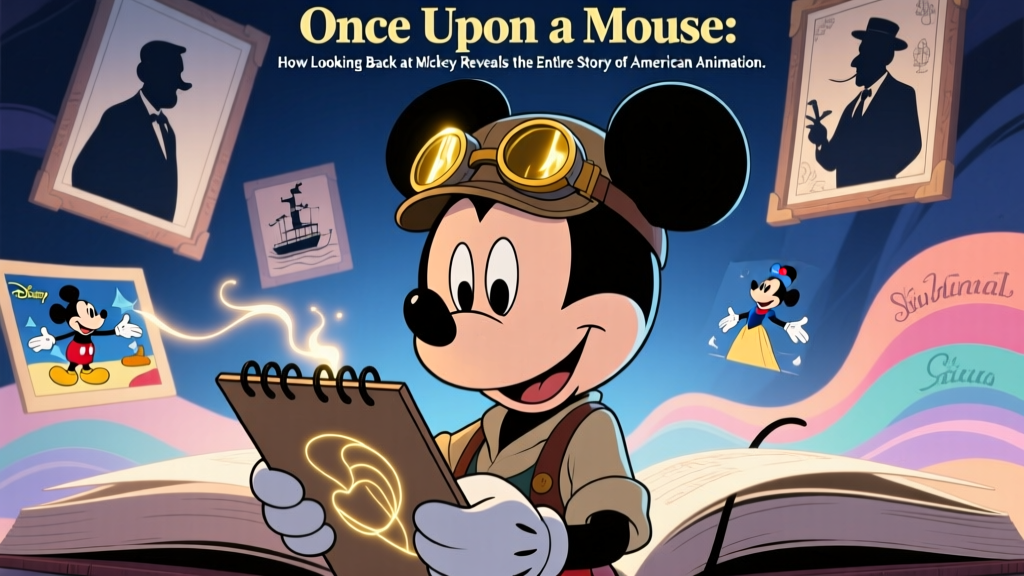
There is a sequence in Disney's 2001 direct-to-video film Mickey's Magical Christmas: Snowed in at the House of Mouse where archival footage of Mickey Mouse is spliced between new animation, creating a kind of unintentional documentary. You watch the mouse age in reverse and forward simultaneously: the pie-eyed, rubber-limbed creature of 1928 gives way to the pear-shaped, pupil-eyed charmer of 1939, who yields to the corporate ambassador of the 1980s, who sits beside the scrappy, emotionally volatile character of the 2013 Paul Rudish shorts. Same three-circle silhouette. Completely different animals. That sequence — even in a forgettable holiday special — captures what no single biography has managed: Mickey Mouse is not one character. He is a palimpsest. Each generation writes a new version over the old one, and the old ink never fully disappears.
"Once Upon a Mouse" isn't the title of one specific Disney production. It's a phrase that has attached itself to the broader cultural project of looking backward at Mickey — of tracing his evolution from a desperate animator's last-ditch invention into the most commercially successful cartoon character in human history. Retrospectives bearing this spirit have appeared in books, museum exhibitions, documentary films, limited-edition merchandise lines, and anniversary celebrations. What they all share is a common realization: to tell Mickey's story is to tell the story of animation itself, of American consumer culture, and of how a single image can accumulate meaning across nearly a century.
The Train Ride That Spawned a Thousand Retrospectives
Every Mickey retrospective starts in the same place: a train compartment, somewhere between New York and Los Angeles, February 1928. Walt Disney is twenty-six years old, has just lost the rights to his first successful character (Oswald the Lucky Rabbit), watched most of his animation staff defect to a rival producer, and is heading home to a studio that has no intellectual property, no revenue stream, and no future. The story, as Walt told it in later years, is that he sketched a mouse on the train. His wife Lillian talked him out of the name "Mortimer." He arrived in California with a character concept and nothing else.
The actual history is messier. Ub Iwerks, the one animator who stayed loyal, did the heavy visual lifting. The first two Mickey shorts — Plane Crazy and The Gallopin' Gaucho — were produced as silent films and went nowhere. It was only when Walt bolted synchronized sound onto the third attempt, Steamboat Willie, that the character caught fire. The short premiered at the Colony Theatre on Broadway on November 18, 1928, and the audience demanded encores. That date is now recognized as Mickey's official birthday.
The production cost of Steamboat Willie was approximately $4,986 — a figure Walt financed by selling Lillian's car and borrowing against their home. Adjusted for inflation, that's roughly $91,000 in 2026 dollars. The return on that investment was a corporation that reported $91.4 billion in revenue for fiscal year 2024. Not many seed-stage investments have produced a better ratio.
"I only hope that we never lose sight of one thing — that it was all started by a mouse." — Walt Disney, October 1971, at the dedication of Walt Disney World
That quote, more than any other, anchors the retrospective impulse. Walt understood — perhaps better than anyone who has ever built a media company — that origin stories carry weight. The mouse wasn't just a product. The mouse was proof that catastrophic failure could produce something permanent. Every "Once Upon a Mouse" retrospective, regardless of format, circles back to this emotional core: the idea that rock bottom can be a launchpad.
The Five Mickeys: A Taxonomy of Reinvention
Spend enough time with Mickey retrospectives — and there are more of them than any single character probably deserves — and a pattern emerges. Mickey has effectively been five different characters across his 97-year history, each one reflecting the era that produced him.
The Trickster (1928–1934)
The original Mickey was closer to Felix the Cat or Charlie Chaplin's Little Tramp than the sanitized mascot most people know today. He was scrappy, sometimes cruel, and genuinely funny. In Barnyard Battle (1929), he wages war. In The Barnyard Broadcast (1931), he kicks a cat. In Steamboat Willie itself, he uses a goose as a musical instrument by squeezing its beak. This Mickey was a creature of impulse, operating in a world without rules — which made him enormously popular with Depression-era audiences who had their own reasons for resenting authority.
The studio produced 87 theatrical shorts starring Mickey between 1928 and 1934, releasing them at a pace that sometimes exceeded one per month. These weren't carefully planned franchise entries. They were assembly-line comedy products, designed to fill the slot between a newsreel and a feature film, and their energy reflects that urgency.
The Company Man (1935–1953)
The shift began with color. The Band Concert (1935), Mickey's first Technicolor short, gave him the red shorts and yellow shoes that became his permanent outfit. But the visual upgrade came with a personality downgrade — or at least, a personality flattening. As Mickey became Disney's primary brand ambassador, the character lost his edge. He became polite, responsible, and safe. Audiences and censorship boards approved. Comedians, less so.
Walt Disney acknowledged the trade-off privately and compensated by routing all the chaos and personality through supporting characters: Donald Duck (introduced 1934, permanently furious), Goofy (1932, permanently incompetent), and Pluto (1930, permanently driven by instinct). Mickey became the straight man — the still point around which the comedy rotated. This is the version that Fred Moore redesigned in 1939, giving him pupils, a pear-shaped body, and softer features. It's the "classic Mickey" that appears on vintage merchandise and serves as the default logo character to this day.
The Television Host (1955–1983)
The Mickey Mouse Club, which premiered on ABC on October 3, 1955, repositioned Mickey as a children's television personality. The show was structured around real children (the "Mouseketeers") performing skits, songs, and serialized adventures, with Mickey serving as symbolic host and mascot. His last theatrical short of this era, The Simple Things, had been released in 1953. For nearly three decades, Mickey existed primarily on television and in merchandise rather than in new theatrical animation.
This period also saw Mickey's voice transition. Walt Disney had personally voiced Mickey from 1928 through 1947 — over 120 theatrical shorts — before handing the role to Jimmy MacDonald, a studio sound effects artist. MacDonald maintained the voice until 1977, followed by Wayne Allwine (1977–2009), who studied Walt's original recordings as his reference point. The voice lineage continues today with Bret Iwan, making Mickey one of the few animated characters whose vocal performance has been passed down through four direct successors, each trained on the original.
The Heritage Brand (1983–2012)
After Walt's death in 1966, Mickey drifted. Without Walt's personal instincts guiding the character, he lacked direction. Mickey's Christmas Carol (1983) was well-received, but Scrooge McDuck carried the dramatic weight. Mickey's role was essentially that of a narrator — present but not central. The solution Disney's management settled on was to reposition Mickey as a heritage icon rather than an active character. He became the face on the shirt, the silhouette on the hat, the shape of the waffle at the resort breakfast buffet. His value was no longer in his stories but in his recognition.
During this era, Disney's licensing operation grew into the largest on Earth. According to Variety's 2025 Global Licensor Report, Disney licensed products generated $63 billion in global retail sales in 2024 — the highest of any licensor on the planet. Mickey Mouse merchandise accounts for a significant share of that total. The three-circle silhouette became a visual language that required no translation, appearing on Uniqlo t-shirts, Gerald Genta luxury watches, and everything between.
The Comeback Kid (2013–Present)
The 2013 Mickey Mouse shorts series on Disney Channel, with Chris Diamantopoulos voicing a scrappier, more emotionally volatile version of the character, was the most successful attempt to give Mickey a personality independent of Walt. These shorts were deliberately anarchic — Mickey gets sunburned, panics in traffic, fights with Minnie over a GPS system. The humor was closer to the 1930s trickster than the sanitized mascot of the intervening decades. The series won five Emmy Awards and proved that Mickey could still generate genuine laughter when someone was willing to let him be flawed again.
| Era | Years | Personality | Key Visual Change | Representative Work |
|---|---|---|---|---|
| The Trickster | 1928–1934 | Scrappy, mischievous, sometimes cruel | Pie-cut eyes, rubber-hose limbs, no pupils | Steamboat Willie, Barnyard Battle |
| The Company Man | 1935–1953 | Polite, responsible, universally likable | Fred Moore redesign: pupils, pear-shaped body | The Band Concert, Fantasia |
| The TV Host | 1955–1983 | Ceremonial figurehead, children's brand anchor | Walkaround costume, fixed proportions for parks | The Mickey Mouse Club, early park appearances |
| The Heritage Brand | 1983–2012 | Logo, silhouette, legacy symbol | Three-circle mark as standalone corporate identity | Mickey's Christmas Carol, merchandise lines |
| The Comeback Kid | 2013–present | Volatile, emotional, deliberately imperfect | Varied art styles, expressive squash-and-stretch | Paul Rudish shorts, The Wonderful World of Mickey Mouse |
Mickey in Comics: The Floyd Gottfredson Years Nobody Talks About
Animation retrospectives dominate Mickey coverage, but his comic strip history is arguably where the character did his most interesting storytelling — and where "Once Upon a Mouse" style retrospectives find their richest material.
The Mickey Mouse comic strip launched on January 13, 1930, with Walt Disney himself writing the first few months of scripts before handing the reins to Floyd Gottfredson, a young animator-turned-cartoonist who would draw the strip for the next 45 years. Gottfredson's Mickey was not the sanitized film character. He was an adventurer — a scrappy, resourceful problem-solver who tangled with criminals, explored lost civilizations, and occasionally flew airplanes into volcanic eruptions.
Under Gottfredson, the strip ran as a serialized adventure comic, with story arcs lasting weeks or months. Mickey fought a villain called the Phantom Blot (introduced 1939), traveled to a subterranean kingdom beneath the Himalayas, and solved mysteries that anticipated the plot structures of Indiana Jones by four decades. The strip was syndicated in over 120 newspapers at its peak and translated into 30 languages, making it one of the most widely distributed comic strips in history.
Gottfredson retired in 1975, and the adventure strip gradually gave way to gag-a-day formats and eventually to European-produced stories that dominate Mickey comics today. The Italian Disney comics operation, particularly the Topolino magazine published by Panini (and previously by Mondadori), has produced thousands of Mickey stories since the 1930s, many with a sophistication and narrative ambition that American audiences have never seen. A few standout Gottfredson arcs that retrospective collectors consistently cite:
- Mickey Mouse Sails the High Seas (1934) — a pirate adventure that prefigured Pirates of the Caribbean by seven decades, with Mickey matching wits against a crew of cutthroats across 38 daily strips.
- The Phantom Blot (1939) — the introduction of Mickey's most psychologically complex antagonist, a villain who communicates through cryptic notes and whose identity remained hidden for the entire serial run.
- Mickey Mouse and the 'Lectrobok (1941) — a science-fiction arc featuring an electronic book that predicts the future, published years before tablet computers existed outside of laboratory prototypes.
Italian Mickey stories have tackled time travel, existential philosophy, and literary adaptations — a far cry from the "Mickey fixes a problem at the picnic" format that dominates American output.
The Fantagraphics Reprints: A Retrospective in Book Form
Between 2011 and 2023, Fantagraphics Books published the complete Floyd Gottfredson Mickey Mouse comic strip in a 14-volume archival series called The Floyd Gottfredson Library of Disney Mickey Mouse. Each volume includes restoration of the original artwork, historical essays, and context about the strip's place in comics history. The series is widely considered the definitive Mickey retrospective in print form and retailed for approximately $30 per volume. Collectors seeking the complete set now pay $350–$500 on the secondary market, with early volumes (particularly Volume 1, which covers 1930–1931) commanding the highest prices due to smaller initial print runs.
Retrospectives on Screen: The Documentaries That Tried to Capture a Mouse
The impulse to look backward at Mickey has produced a small library of documentary and retrospective content. Some of it is promotional. Some is genuinely illuminating. A few entries stand out as required viewing for anyone trying to understand the character beyond the merchandise.
Mickey: The Story of an Icon (2008)
Produced for the Walt Disney Family Museum, this documentary traces Mickey from the train ride through the modern era, with particular emphasis on the creative decisions that shaped each iteration. The film includes interviews with animators who worked on Mickey shorts in the 1930s and 1940s — many of whom were in their 80s and 90s at the time of filming and have since passed away. Their recollections of Walt Disney's creative process, delivered in unhurried Midwestern cadences, are among the most valuable primary sources about Mickey's development.
Walt Before Mickey (2015)
This independent biographical film focuses on Walt Disney's pre-Mickey years — the Kansas City period, the loss of Oswald, the train ride, and the first Mickey shorts. It's not a polished production (the budget was reportedly under $2 million, which shows in places), but it dramatizes events that most retrospectives only describe, giving viewers a sense of the desperation and creative urgency that produced the character. Thomas Ian Nicholas plays Walt as a man who is not yet successful but cannot stop working.
Mickey Mouse: The Story of America's Favorite Mouse (ABC, 1988)
Produced for Mickey's 60th birthday, this television special aired on ABC and featured a mix of archival footage, celebrity interviews, and new animation. It captured Mickey at a cultural inflection point — old enough to be nostalgic, young enough to still be commercially relevant. The special included rare footage from the Disney vaults, including test animation for abandoned Mickey projects that had never been publicly screened. Footage of Walt Disney recording Mickey's voice in the 1940s — shot from behind a glass partition, cigarette in hand — remains one of the most intimate glimpses of the creator-character relationship ever broadcast.
D23 Expo Retrospectives (2009–Present)
Disney's official fan convention, D23 Expo, has hosted multiple Mickey-focused retrospective panels since its launch in 2009. These panels, typically led by Disney archivists and historians, have premiered restored shorts, announced anniversary merchandise lines, and occasionally revealed production materials that had been locked in the Disney Animation Research Library for decades. The 2018 panel celebrating Mickey's 90th birthday included a side-by-side comparison of Mickey's design across 12 different decades, projected on a 40-foot screen — a visual that made the character's evolution viscerally clear in a way that no written retrospective could match.
Collecting the Mouse: What Memorabilia Tells You About Cultural Memory
Mickey Mouse collectibles are a market unto themselves — one that operates with its own pricing logic, generational cycles, and emotional drivers. Unlike most collectibles markets, where scarcity is the primary value driver, Mickey memorabilia is driven by something more complex: the intersection of scarcity, nostalgia, and cultural recognition. A Mickey item doesn't need to be rare to be valuable. It needs to be from the right moment.
| Item | Year Produced | Original Price | Current Market Value | Why It Matters |
|---|---|---|---|---|
| Ingersoll Mickey Mouse watch | 1933 | $2.75 | $1,500–$5,000 | First character watch ever mass-produced; sold 2.5M units in two years and saved Ingersoll-Waterbury from bankruptcy |
| Seiberlich Mickey Mouse milk bottle | 1931–1935 | Cost of a bottle of milk | $400–$2,500 | Regional dairy promotion; surviving examples are scarce due to glass fragility |
| Charlotte Doll Mickey Mouse stuffed doll | 1933 | $1.50 | $1,000–$8,000 | One of the earliest licensed Mickey plush toys; handmade construction with embroidered features |
| Walt Disney hand-drawn Mickey sketch (signed) | Various (1930s–1960s) | Free (given to fans) | $150,000–$500,000+ | Personal autograph sketches; finite supply since Walt's death in 1966 |
| Fantasia Sorcerer's Apprentice production cel | 1940 | N/A (studio prop) | $12,000–$16,800 | Original hand-painted cels from Mickey's most iconic sequence; authenticated examples through Heritage Auctions |
| "Mickey Mouse Through the Years" limited lithograph | 1990s | $250 | $800–$2,500 | Numbered editions with design elements spanning Mickey's history |
| Fantagraphics Gottfredson Library (complete 14-volume set) | 2011–2023 | ~$420 (retail) | $350–$500 | Definitive Mickey comics retrospective in print; early volumes out of print |
The Ingersoll watch story is worth dwelling on. In 1933, at the depth of the Great Depression, the Ingersoll-Waterbury Clock Company was weeks away from shutting down permanently. They licensed the Mickey Mouse image for a children's watch priced at $2.75 — roughly $63 in 2026 dollars. The watch sold 2.5 million units in its first two years. Ingersoll-Waterbury survived. Later absorbed into Timex, the company became one of the largest watch manufacturers in the world. A cartoon mouse saved a factory full of jobs during the worst economic crisis in American history. That's not a marketing claim. That's documented industrial history.
For modern collectors, the generational nostalgia cycle is the primary engine driving prices. Baby Boomers who grew up with The Mickey Mouse Club are now in their 60s and 70s with disposable income and emotional attachment. Gen X collectors who remember the Disney Afternoon era of the early 1990s are entering their peak earning years. Each generation bids up the memorabilia of their own childhood, creating overlapping demand waves that push prices upward across multiple categories simultaneously.
The Public Domain Question
On January 1, 2024, the copyright on the original 1928 Steamboat Willie version of Mickey Mouse expired. That specific design — black-and-white, pie-eyed, no gloves — entered the public domain. Anyone can now reproduce it, adapt it, or sell merchandise featuring it. Within weeks, independent filmmakers announced horror movies starring the 1928 Mickey. Indie game developers released platformers. A brewery in Portland launched a "Steamboat Willie" IPA with the original mouse on the label.
Disney's trademark on the modern Mickey design and the three-circle silhouette, however, remains fully enforceable. Trademark law does not expire as long as the mark is in active commercial use, and Disney uses Mickey extensively across all media and merchandise. The result is a bifurcated legal landscape: the 1928 mouse belongs to everyone, but the modern mouse belongs to Disney — and the boundary between them is enforced aggressively by a company that spends an estimated $30–50 million annually on IP enforcement.
The Broader Canvas: What Mickey's Story Says About Animation Itself
Here's the thing about Mickey retrospectives that makes them more interesting than retrospectives about, say, Bugs Bunny or Popeye. Mickey's evolution mirrors the entire trajectory of American animation as an industry and an art form. Every major transition in animation history has a Mickey Mouse example attached to it.
- The shift from silent to sound film — Steamboat Willie (1928). Walt bolted synchronized sound onto a cartoon and audiences demanded encores.
- The arrival of Technicolor — The Band Concert (1935). Mickey stepped into color for the first time, red shorts blazing.
- The ambition to make animation into high art — Fantasia (1940). A $2.28 million gamble on classical music and no dialogue.
- The transition to television — The Mickey Mouse Club (1955). Daily weekday programming beamed directly into American living rooms.
- Theme park entertainment as cultural force — Disneyland's opening day (1955), with Mickey as the physical host greeting guests in costume for the first time.
- The revival of short-form animation through streaming — The Paul Rudish Mickey Mouse shorts (2013). Three-and-a-half-minute episodes that won five Emmy Awards.
No other animated character has been present at every one of these inflection points. Bugs Bunny arrived in 1940 — too late for the silent-to-sound transition. Popeye was a newspaper character first and never anchored a theme park. Even characters from the anime tradition — Astro Boy, Goku, Pikachu — have gaps in their historical coverage. Mickey's continuous presence since 1928 makes him the only character whose retrospective is simultaneously a history of the medium itself.
"Mickey Mouse has been the canary in the coal mine for every major shift in entertainment media. When Mickey changes, the industry is about to change too." — Garry Apgar, A Mickey Mouse Reader (2014), analysis of character longevity
The Walt Disney Family Museum in San Francisco, which opened in 2009, maintains a permanent Mickey retrospective exhibition that occupies roughly 4,000 square feet of gallery space. The exhibition is organized chronologically and includes original production cels, concept artwork, merchandise prototypes, and personal correspondence between Walt Disney and his animators about Mickey's character direction. For anyone within traveling distance of the Presidio, it remains the most comprehensive "Once Upon a Mouse" experience available — a physical space where the mouse's entire history is laid out under one roof.
What Happens When the Mouse Turns 100
Mickey Mouse will celebrate his centennial in 2028. Disney has already begun planning. Industry analysts expect merchandise tied to the centennial to push Disney's annual licensing revenue significantly beyond the $63 billion mark set in 2024. Limited-edition retrospectives — books, documentary films, collectible sets, anniversary merchandise — will flood the market in a wave that began quietly in 2025 and will peak in late 2028.
But the centennial also raises a question that has no clean answer: what does a 100-year-old cartoon character owe his audience? Mickey has survived because Disney has been willing to rewrite him for each era — to sacrifice consistency for relevance, to let each generation's Mickey be different from the last. The risk is that by the time the 100th anniversary arrives, the character has been reinvented so many times that no single version carries enough emotional weight to anchor a meaningful celebration.
The counterargument is that reinvention is the point. Mickey isn't valuable because any one version of him is perfect. He's valuable because the process of reinventing him — of looking back at what he was and deciding what he should be next — is itself the most interesting story in animation. Every retrospective, every "Once Upon a Mouse" excavation, every collector who pays $5,000 for a 1933 Ingersoll watch is participating in that process. They're not preserving the past. They're arguing about what the past means.
And that argument — about a mouse drawn by a desperate 26-year-old on a train in 1928 — is still going. No sign of stopping.