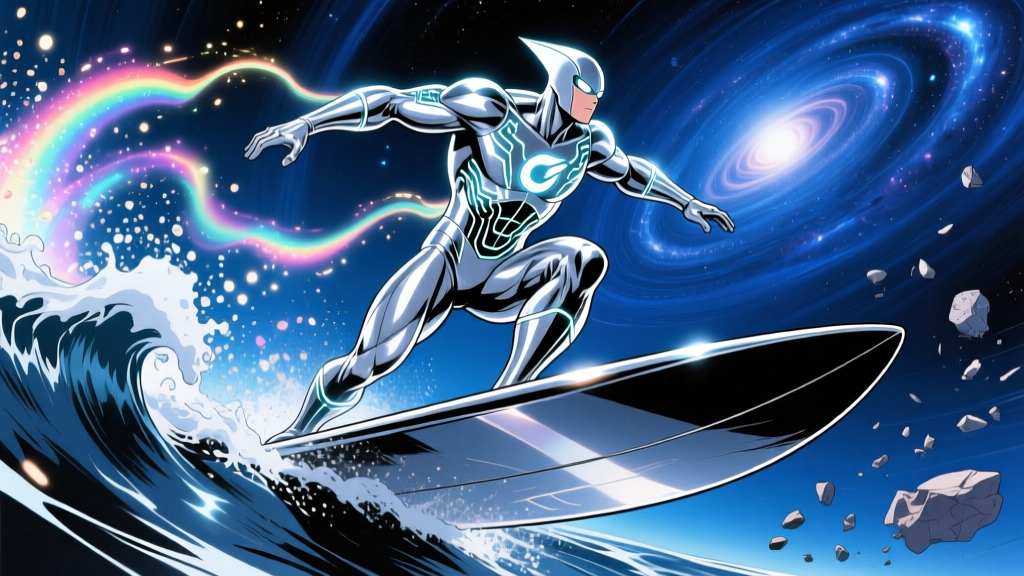
It was March 1966, and ten-year-old kids across America plunked down twelve cents at the drugstore spinner rack expecting another routine Fantastic Four adventure. What they got instead was something nobody at Marvel Comics had advertised, teased, or even mentioned in the previous issue's letter column. Halfway through Fantastic Four #48, a sleek chrome figure on a flying surfboard streaked across Jack Kirby's panels with zero explanation—no origin, no name, no backstory. He simply appeared in the sky above Manhattan like a meteor that decided to stop falling. The kids staring up at those pages had no idea they were witnessing the birth of one of the most philosophically complex characters in comic book history.
If you search for the first Silver Surfer comic, the answer is technically straightforward: Fantastic Four #48, cover-dated March 1966, published by Marvel Comics. But the real story behind those three issues—the now-legendary Galactus Trilogy spanning FF #48 through #50—is anything but straightforward. It involves an unapproved creative decision by one of the greatest artists in the medium, a writer who scrambled to make sense of a character he never planned, and a readership that turned a one-shot herald into an unlikely existential hero.
The Unplanned Birth of Marvel's Most Philosophical Hero
Here is what actually happened inside the Marvel offices at 655 Madison Avenue. Stan Lee and Jack Kirby had plotted Fantastic Four #48 as the opening chapter of an ambitious three-part arc introducing a planet-devouring cosmic entity called Galactus. In Lee's original outline, Galactus arrived on Earth, the Fantastic Four fought him, and eventually drove him off. Straightforward superhero fare. But when Kirby began penciling the pages, he decided on his own that a being as immense as Galactus would need an advance scout—a herald who flew ahead to scout worlds marked for consumption.
Kirby never told Lee about this addition. He simply drew the character into the pages: a tall, silver-skinned figure riding what looked like a cosmic surfboard, trailing energy behind him like an afterburner. When Lee received the finished pencils and saw this unnamed chrome figure soaring through panels he had never scripted, he was reportedly baffled. In Stan Lee Meets the Marvel Universe (2007), Lee recalled thinking the surfboard motif seemed "kind of crazy" at first glance. But rather than ask Kirby to erase the character, Lee leaned into it. He gave the Surfer a voice, a personality, and eventually a moral crisis that would elevate the entire trilogy beyond a standard monster-of-the-month plot.
"I couldn't believe what Jack had done. There was this beautiful, noble figure—and I had no idea who he was or what he was doing there. But I knew right away we couldn't get rid of him."
— Stan Lee, interview for Comic Book Artist #12 (2001)
The character didn't even have a name in that first issue. He was simply credited as "the Surfer" in the dialogue balloons. The full moniker Silver Surfer emerged over the following months as fans and the Marvel Bullpen started referring to him that way. By Fantastic Four #50, the name had stuck.
The Galactus Trilogy: Fantastic Four #48-50, Issue by Issue
Understanding why the first Silver Surfer comic resonates requires walking through what happens across these three issues. The trilogy works as a single continuous narrative, something almost unheard of in mainstream comics at the time.
Fantastic Four #48 — "The Coming of Galactus!"
The Silver Surfer's herald arrives on Earth, generating massive atmospheric disturbances. The Fantastic Four investigate and encounter the Surfer, who is visibly awed by humanity but bound by duty to his master. Galactus himself appears on the final pages—a towering figure in purple armor who treats the destruction of entire civilizations as a mundane act of sustenance. The issue ends on a cliffhanger that must have had twelve-year-old readers climbing the walls. What's remarkable about the Surfer's introduction here is how little screen time he gets. He appears in roughly six panels across the entire issue. Yet his visual impact is so overwhelming that he dominates the reader's memory of the story.
Fantastic Four #49 — "If This Be Doomsday!"
Galactus begins preparing to drain Earth's life energy. The Silver Surfer, meanwhile, encounters Alicia Masters, the blind sculptor and love interest of Ben Grimm (The Thing). Alicia's ability to perceive the Surfer's inner nobility—she literally feels his face with her hands and recognizes sadness beneath the chrome exterior—becomes the emotional pivot of the entire trilogy. This is where Lee and Kirby transform the Surfer from a plot device into a character. His growing attachment to humanity, sparked by Alicia's compassion, sets up his ultimate betrayal of Galactus. The issue also features the Watcher, Uatu, breaking his oath of non-interference to help the FF, which gives you a sense of how high the stakes were supposed to feel.
Fantastic Four #50 — "The Startling Saga of the Silver Surfer!"
The climax. The Silver Surfer openly defies Galactus to protect Earth, engaging his former master in a battle he cannot possibly win. Reed Richards, meanwhile, threatens Galactus with the Ultimate Nullifier—a weapon capable of erasing entire realities. Galactus relents, sparing Earth but punishing the Surfer by erecting an invisible barrier around the planet that traps him here, exiled from the cosmos he once roamed freely. That ending—the Surfer stranded on Earth, howling in anguish at the sky—is one of the most emotionally raw moments in 1960s comics. It also established the central tension that would drive the character for decades: a godlike being imprisoned on a world he grows to love but can never fully belong to.
Kirby's Cosmic Blueprint: Why the Design Still Holds Up
Strip away the story for a moment and consider the Silver Surfer purely as a visual creation. Jack Kirby designed a character that had no precedent in comics or science fiction. In 1966, the dominant visual language for aliens and cosmic beings leaned toward bug-eyed monsters, robots with rivets, or humanoid figures in jumpsuits. Kirby went in a completely different direction.
The Surfer's body is smooth, almost liquid—no visible seams, no costume lines, no muscle definition beyond a suggestion of athletic form. His skin reflects light in a way that suggests polished metal rather than flesh, yet he moves with a fluidity that makes him feel organic. The surfboard itself is arguably the boldest choice. It could have looked absurd. Instead, Kirby integrated it so thoroughly into the character's silhouette—the arched back, the outstretched arms, the board trailing cosmic energy—that it became inseparable from the character's identity. Try to imagine Silver Surfer without the board. You can't. It's the only vehicle in comics that functions as a character trait rather than a prop.
Kirby's inker on these issues was Joe Sinnott, whose contribution to the Surfer's final appearance cannot be overstated. Sinnott's heavy, confident ink lines gave the Surfer his chrome sheen—the way light plays across his form in high-contrast highlights and deep shadows. Without Sinnott's finish, the Surfer might have looked flat. With it, he practically leaped off the page. The pairing of Kirby's dynamic layouts and Sinnott's rich inks produced some of the most visually striking panels in Marvel history, particularly the double-page spread in FF #49 where the Surfer soars above the clouds.
Design Breakdown: What Made the Silver Surfer Visually Unique in 1966
- Seamless chrome skin — No costume, no insignia, no visible joints. Just a continuous reflective surface that made him look like a living sculpture.
- The Power Cosmic energy trails — Kirby drew energy flowing from the Surfer's hands and board in sweeping, organic curves rather than standard comic lightning bolts.
- Surfboard as extension of body — The board responds to thought, not physical contact. It arrives when summoned and vanishes when not needed.
- Facial features — Angular, almost classically handsome, with a perpetually mournful expression that communicated pathos before a single word of dialogue appeared.
- Minimalist color palette — In an era of garish superhero costumes, the Surfer's monochromatic silver stood out on the newsstand like a mirror in a paint factory.
Readers Lost Their Minds (In the Best Way)
Marvel's mailroom started flooding within weeks. According to The Comic Book Makers of the Marvel Age by Blake Bell (2005), Fantastic Four received more fan mail about the Silver Surfer in the spring of 1966 than about any other single character that year—including Spider-Man, who had been the company's bestseller since 1963. Readers didn't just like the Surfer. They were obsessed. They wanted to know his origin. They wanted to know his real name. They wanted to know if he would ever escape Earth's atmosphere and return to the stars.
The intensity of the reaction surprised everyone at Marvel, including Kirby himself. In a 1990 interview with The Jack Kirby Collector, Kirby's assistant Mark Evanier noted that Kirby considered the Surfer "just another character" when he drew him—a cosmic sidekick to make Galactus feel more imposing. The audience had other plans. They saw something in the Surfer that went beyond standard superhero appeal: a lonely, beautiful alien wrestling with the question of whether humanity deserved to survive. That question resonated in 1966 for the same reason it resonates now—it was the height of the Vietnam War, the civil rights movement was reshaping American identity, and young people were asking uncomfortable questions about power, responsibility, and the cost of obedience.
Lee responded to the demand by weaving the Silver Surfer into subsequent Fantastic Four issues. The character appeared in FF #55 (October 1966), where he first battled the Mephisto-empowered Flying Dutchman, and again in #57-60 (December 1966 through March 1967), where he teamed up with the FF against Doctor Doom, who stole the Surfer's Power Cosmic in one of the most memorable storylines of the era. Each appearance deepened the character's mythology and increased fan pressure for a dedicated series.
Key Early Appearances and the Road to a Solo Series
Before Marvel launched The Silver Surfer as a standalone title in August 1968, the character accumulated a substantial resume of guest appearances that fleshed out his origin and established his place in the Marvel Universe. The most significant of these early stories is Fantastic Four Annual #5 (November 1967), which finally revealed the Surfer's origin: he was Norrin Radd, a young astronomer from the planet Zenn-La who volunteered to become Galactus's herald in exchange for sparing his homeworld. This backstory transformed the character from a mysterious cosmic wanderer into a tragic figure—a man who sacrificed his own freedom to save his people, only to be stripped of his memories and sent across the galaxy as an instrument of destruction.
The 1968 solo series, The Silver Surfer, was significant for several reasons. It was Marvel's first comic to carry a 25-cent cover price (standard comics were still 12 cents), and it shipped in a larger "King-Size" format with roughly 72 pages per issue. John Buscema took over art duties from Kirby, and his more classical, anatomically precise style gave the Surfer a sculptural quality that complemented the character's philosophical monologues. The series ran for 18 issues (August 1968 through September 1970) and featured stories by Lee that tackled racism, environmental destruction, and the dehumanizing effects of technology—heavy subject matter that comics rarely addressed at the time. Issue #1 introduced Mephisto as the Surfer's primary antagonist, a Satanic figure who spent the entire series trying to corrupt the Surfer's moral compass. It was ambitious, often overwrought, and utterly unlike anything else on the newsstand.
| Issue | Date | Significance | CGC 9.0 Value | CGC 9.8 Value |
|---|---|---|---|---|
| Fantastic Four #48 | March 1966 | First appearance of Silver Surfer | $4,500–$6,500 | $35,000–$65,000 |
| Fantastic Four #49 | April 1966 | Surfer allies with humanity; Galactus prepares to devour Earth | $1,200–$2,000 | $8,000–$15,000 |
| Fantastic Four #50 | May 1966 | Trilogy conclusion; Surfer exiled to Earth | $1,500–$2,500 | $10,000–$18,000 |
| Fantastic Four Annual #5 | November 1967 | Origin of Norrin Radd revealed | $400–$800 | $3,500–$6,000 |
| Silver Surfer #1 | August 1968 | First solo series; Mephisto introduced | $600–$1,200 | $5,000–$9,000 |
| Silver Surfer #4 | February 1969 | Jack Kirby's final issue on the series; widely considered his best Surfer art | $200–$450 | $1,800–$3,500 |
| Silver Surfer #18 | September 1970 | Final issue of original solo run | $80–$180 | $600–$1,200 |
Values based on 2024–2025 CGC census data, Heritage Auctions realized prices, and GoCollect market aggregators. Actual sale prices vary by eye appeal, page quality, and market conditions.
A few things jump out from that table. Fantastic Four #48 commands a significant premium over #49 and #50 despite being part of the same story arc, purely because it carries the "first appearance" designation. Collectors have always gravitated toward debut issues, and the Surfer's is no exception. The gap between CGC 9.0 and CGC 9.8 values is enormous—reflecting how few near-mint copies of these 1966 issues have survived. Newsprint paper from that era degrades aggressively, and most copies were read, folded, stuffed into back pockets, and eventually thrown away by parents who didn't know they were sitting on mortgage payments.
What Made the Surfer Different From Every Other Cosmic Character
Science fiction comics in the mid-1960s were dominated by two archetypes: the heroic space explorer (Flash Gordon, Buck Rogers) and the threatening alien invader. Silver Surfer fit neither category. He was something new—a cosmic being with near-limitless power who was defined not by what he could do, but by what he refused to do. He could level cities. He could punch through planets. He chose instead to float above them, watching, mourning, questioning.
This philosophical dimension was Lee's contribution to the character, and it distinguished the Surfer from every other power-fantasy hero on the market. In the solo series, Lee wrote the Surfer's internal monologues in a heightened, almost poetic register—sentences that stretched across entire panels, pondering the cruelty and beauty of the human condition. It was purple prose by any objective measure, but it worked because the character's visual grandeur matched the tone. When a gleaming silver demigod stares down from a mountaintop and laments humanity's capacity for violence, the melodrama feels earned.
The Surfer's existentialism also connected with the counterculture movement of the late 1960s. College students who wouldn't touch a Superman comic were drawn to a character who questioned authority, rejected blind loyalty, and chose exile over servitude. Surfer posters appeared in dorm rooms alongside Hendrix and Che Guevara. The character became, somewhat accidentally, a symbol of the era's idealism—a being with the power to change everything who was trapped by the very systems he once served.
From Newsprint to the Big Screen: The Surfer's Long Afterlife
The character's influence extends well beyond the pages where he first appeared. Silver Surfer has headlined four solo ongoing series (1968, 1987, 2003, and 2014), appeared in over 200 Marvel titles as a guest or supporting character, and been adapted into animation six times, beginning with the 1967 Fantastic Four cartoon produced by Hanna-Barbera. The character's most controversial live-action appearance came in Fantastic Four: Rise of the Silver Surfer (2007), where the practical suit design drew criticism for deviating significantly from Kirby's clean, seamless aesthetic. The 2007 film did, however, introduce the Surfer to a generation of viewers who had never read a comic, and it drove a measurable spike in demand for FF #48—48% price increases in the six months following the film's theatrical release, according to GoCollect's market tracking.
More recently, the Silver Surfer (reimagined as Shalla-Bal, Norrin Radd's lover from Zenn-La) appeared in The Fantastic Four: First Steps (2025), played by Julia Garner. That film's version of the character drew directly from the Galactus Trilogy's emotional core—the tension between cosmic duty and personal loyalty—while updating the mythology for the MCU. Comic values for the Surfer's key issues saw another bump in the months surrounding the film's release, a pattern that has repeated with every major media appearance since 1966.
The creative influence is harder to quantify but arguably more important. The Silver Surfer established a template that Marvel would revisit repeatedly: the noble outsider, torn between allegiance to a cosmic order and empathy for ordinary people. Characters like Vision, Adam Warlock, and even the modern incarnations of Thor owe a clear debt to the Surfer's existential wrestling. Outside Marvel, the character's impact shows up in works as varied as Jean Giraud (Moebius)'s cosmic artwork, the philosophical manga of Naoki Urasawa, and the cosmic mythologies that permeate modern superhero cinema. Whenever a filmmaker puts a godlike character in the position of questioning whether humanity is worth saving, they're walking a path that Lee and Kirby cleared in 1966.
Collecting the First Silver Surfer Comic: What to Watch For
If you're considering acquiring a copy of Fantastic Four #48—the true first Silver Surfer comic—a few practical considerations apply. The issue was printed on cheap newsprint that browns and becomes brittle with age. High-grade copies are genuinely scarce: according to the CGC census (accessed January 2026), only 37 copies have been certified at 9.4 or above out of approximately 2,100 total graded copies. That scarcity drives the steep price curve between grades. A CGC 7.0 (Fine/Very Fine) typically sells in the $1,500–$2,500 range, which puts the issue within reach of serious but not wealthy collectors.
Watch for restored copies. Silver Age Fantastic Four issues were commonly restored in the 1970s and 1980s—color touch, piece replacement, and trimming are all frequent on these books. CGC labels restored copies with a purple label and detailed restoration notes, and while restored copies are still collectible, they trade at 40–60% discounts compared to unrestored equivalents. For investment purposes, an unrestored copy with original covers and solid page quality (OW to OW/W) will always outperform a restored copy regardless of technical grade.
The complete Galactus Trilogy (FF #48–50) in matching grades is significantly harder to assemble than any single issue. Sets in uniform CGC 8.0 or better are uncommon enough that they command a 15–20% premium over the sum of individual issue values when sold together at auction. Heritage Auctions has sold several matched sets in recent years, with a complete 9.4 set realizing $14,400 in their 2024 Winter sale.
Frequently Asked Questions
What is the first Silver Surfer comic?
The first Silver Surfer comic is Fantastic Four #48, cover-dated March 1966, written by Stan Lee and penciled by Jack Kirby. The character appears mid-issue without any prior introduction, serving as the herald of Galactus. His full identity as Norrin Radd of Zenn-La was not revealed until Fantastic Four Annual #5 in November 1967.
Did Jack Kirby create the Silver Surfer without Stan Lee's approval?
Effectively, yes. Kirby added the Silver Surfer to the pencils of Fantastic Four #48 without informing Lee beforehand. Lee discovered the character when he received the finished pages. Rather than remove the Surfer, Lee wrote dialogue and narrative around him, developing the character's voice and personality. This collaborative improvisation—Kirby's visual invention paired with Lee's literary response—is one of the most famous examples of the "Marvel Method" of comic production, where artists plotted visually and writers added dialogue afterward.
How much is Fantastic Four #48 worth in 2026?
Values depend heavily on condition. A low-grade copy (CGC 3.0–4.0) typically sells for $400–$800. Mid-grade copies (CGC 6.0–7.0) range from $1,500 to $2,500. High-grade unrestored copies (CGC 9.0+) can reach $4,500 to $6,500, with the rare CGC 9.8 copies commanding $35,000 to $65,000 or more at auction. The highest publicly recorded sale was a CGC 9.8 that sold for $72,000 through Heritage Auctions in 2023.
Why does the Silver Surfer carry a surfboard?
The surfboard was Jack Kirby's idea, and it was a deliberate visual gamble. Kirby wanted the Surfer to have a mode of transportation that felt organic and unconventional—something that didn't look like a standard spaceship or flying belt. The surfboard shape allowed Kirby to draw dynamic, flowing poses that would be impossible with a character simply flying under his own power. Within the story, the board is an extension of the Power Cosmic that Galactus grants his heralds; it responds to the Surfer's thoughts and can reshape, extend, or dematerialize at will.
What was the Silver Surfer's original solo series, and why was it canceled?
The Silver Surfer (1968) ran for 18 issues before cancellation. It was Marvel's first 25-cent comic, printed in an oversized format. The high price point limited its audience at a time when most comics cost 12 cents. Additionally, Lee's increasingly philosophical writing—lengthy internal monologues about the human condition—appealed to older readers but may have alienated younger fans who wanted more action. Despite its short run, the series is now regarded as one of the most ambitious comics Marvel published during the Silver Age.
Is the Galactus Trilogy worth reading today?
Absolutely, with a minor caveat. The storytelling pace of 1966 comics is slower than modern readers expect—there are more exposition panels, more repeated information, and the dialogue can feel theatrical. But the visual storytelling is extraordinary. Kirby's page compositions, the cosmic scale of the conflict, and the genuine emotional weight of the Surfer's exile hold up remarkably well. Marvel's Milestones Edition reprints (which reproduce the original issues at standard size with restored colors) are the most accessible way to experience the trilogy as it was originally printed. The Essential Fantastic Four trade paperback collects the trilogy in black-and-white at a budget price.
Sixty years after a chrome figure silently glided into a Fantastic Four comic that nobody asked for, the Silver Surfer remains one of the most visually arresting and emotionally complex characters in the medium. He was born from an artist's instinct and a writer's improvisation—the kind of creative accident that only happens when talented people trust their impulses. Every collector chasing a high-grade copy of FF #48 is chasing a piece of that accident. Every reader who picks up the Galactus Trilogy for the first time is about to experience it fresh. And that, more than any collector value, is what makes the first Silver Surfer comic worth caring about.