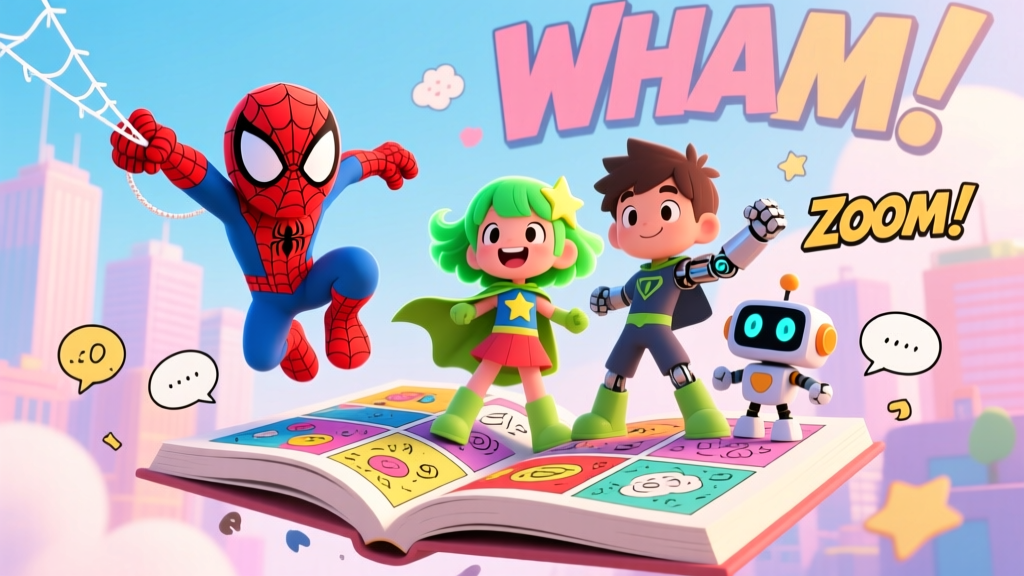
A four-year-old grabs a paperback off the shelf, points at a red-and-blue figure swinging between buildings, and says: "That's Spidey. He helps people." That moment — the one where a preschooler connects with a comic book character before they can even read the speech bubbles — is exactly what Marvel and Disney built Spidey and His Amazing Friends for. The franchise has quietly become one of the most successful all-ages superhero properties of the 2020s, and its growing library of comic tie-ins, picture books, and early-reader graphic novels is where the real depth lives beyond the TV screen.
If you have a kid who watches the show on repeat, or if you are a Spider-Man fan wondering whether these "baby" comics have anything worth your time, this guide covers every angle: the animated series that kicked things off, the comic books and storybooks that expanded the universe, the character design work that made Miles, Gwen, and Peter feel fresh, and where you can actually find these comics today.
A Preschool Spider-Verse That Actually Works
When Disney Branded Television announced a preschool-targeted Spider-Man series in 2019, plenty of longtime fans rolled their eyes. Spider-Man for toddlers? It sounded like a cynical merchandise play. What arrived on August 6, 2021, on Disney Junior, turned out to be something more thoughtful than anyone expected.
Marvel's Spidey and His Amazing Friends follows a younger Peter Parker who splits his time between being a regular kid and fighting crime alongside two equally young allies: Miles Morales (who goes by the hero name Spin) and Gwen Stacy (who becomes Ghost-Spider). The trio operates out of a secret base called WEB-Quarters, gets mission briefings from a friendly AI assistant named TRACE-E, and faces down recognizable villains — Green Goblin, Doctor Octopus, Rhino, Electro, Sandman — scaled down to problems a preschooler can follow: someone stole the bridge, someone is making too much noise, someone won't share.
The show struck a nerve. By early 2022, Disney reported that series content had accumulated nearly 84 million views across platforms. The series was renewed for a second season before the first one finished airing, then a third, then a fourth, and in February 2025, Disney confirmed a fifth season — making it one of the longest-running Marvel animated series in the preschool space. Atomic Cartoons, the Vancouver-based studio behind the animation, developed a bright, rounded, expressive visual style that reads clearly on small screens and translates well to print.
"We wanted kids to see themselves in these heroes. Peter, Gwen, and Miles are little kids solving problems the same way the audience does — they just happen to have superpowers while doing it."- - - - -
— Disney Branded Television production notes, 2021
The Comics and Books: More Than a TV Tie-In
The animated series gave Marvel a foundation, but the print expansion is where Spidey and His Amazing Friends becomes genuinely interesting from a comics perspective. Marvel has released material across several formats, each targeting a different reading level and price point.
Free Comic Book Day Specials
Marvel has used Free Comic Book Day (FCBD) — the annual event where comic shops hand out free issues every May — to promote the Spidey franchise to direct-market audiences who might not pick up a Disney Junior tie-in otherwise.
The first, Spidey and His Amazing Friends Free Comic (2022) #1, dropped on May 4, 2022. Edited by Peter Charpentier, it featured the core trio of Spidey, Ghost-Spider, and Spin facing off against both Green Goblin and Doctor Octopus in a single issue. The story was straightforward — a team-up adventure compressed into about 20 pages — but the art direction stayed faithful to the show's character designs while giving the linework a slightly more traditional comic-book feel.
Two years later, Marvel returned with Free Comic Book Day 2024: Spidey & His Amazing Friends #1. Written by Zeb Wells (who has written extensively on the mainline Amazing Spider-Man title), this issue sent Spidey, Ghost-Spider, and Spin up against Electro in a story that leaned into the "Glow Webs Glow" catchphrase the show introduced in its second and third seasons. Having a writer of Wells' caliber attached to a preschool FCBD issue signals how seriously Marvel treats this corner of the Spider-Man brand.
Marvel Press Storybooks and Early Readers
The bulk of the Spidey and His Amazing Friends print catalog lives under the Marvel Press imprint, distributed by Penguin Random House. These titles span several formats:
- Little Golden Books — Hardcover, 24 pages, ages 2–5. Titles include The Power of Three (ISBN 9780593379332) and Sandman Won't Share! (ISBN 9780593483022). These adapt core episodes into the iconic Golden Book illustration style, with gold foil spines and full-color painted artwork.
- Paperback Storybooks — 24 to 32 pages, ages 3–5. Titles like Panther Patience, Super Hero Hiccups, A Very Spidey Christmas, Construction Destruction, Electro's Gotta Glow, and Pirate Plunder Blunder each tackle a single adventure from the show.
- Board Books — 20 pages, ages 0–3. A Little Hulk Trouble puts a toddler-friendly Hulk story into chunky, tear-resistant pages. Pop-Up Peekaboo! Marvel Spidey and His Amazing Friends from DK Publishing adds lift-the-flap interactivity for infants and toddlers.
- My First Comic Reader — 64 pages, ages 4–6. This is the format closest to an actual comic book. Team Spidey Does It All! (ISBN 9781368076074) and Teamwork Saves the Day! (ISBN 9781368098250) use panel-based storytelling with simplified dialogue and large, clear artwork designed to bridge the gap between picture books and traditional comics.
- World of Reading — 32 pages, ages 3–5. Titles such as Housesitting at Tony's and The Hangout Headache introduce early-reader vocabulary alongside the Marvel characters, functioning as both literacy tools and superhero stories.
The "My First Comic Reader" format deserves particular attention. These 64-page books use the visual grammar of comics — gutters, panels, speech balloons, sound effects — but strip the complexity down so a child who has never held a comic before can follow the sequence. The art stays true to the show's designs, and the stories feel like extended episodes rather than watered-down reprints. For parents who grew up reading Spider-Man Loves Mary Jane or Marvel Adventures Spider-Man, these are a legitimate entry point into shared reading with a young child.
The Glow-Webs-Glow Era
Starting with Season 2, the show introduced "Glow Webs" — webs that light up in various colors and give Team Spidey new abilities. This concept carried into the comics and books, becoming a signature visual element. The Electro's Gotta Glow storybook and the FCBD 2024 comic both lean heavily on Glow Webs as a plot device and visual hook. In Season 3, the character designs received what fans call a "glow-up" — slightly refined costumes with luminous web accents that translated well to print and merchandise.
- - - - -Character Designs: Making Icons Readable for a 3-Year-Old
Adapting Spider-Man for preschoolers is not as simple as making the characters smaller. The design team had to solve a specific problem: how do you make three distinct Spider-heroes recognizable at a glance, expressive enough to convey emotion through an animated pipeline, and appealing enough to anchor an entire merchandise line — all while keeping the designs simple enough for a four-year-old to draw from memory?
Peter Parker / Spidey
The show's Peter is younger and rounder than his mainstream counterpart. His mask features oversized, highly expressive white eye patches that function almost like anime eyes — they widen, narrow, droop, and squint to convey a full emotional range without showing his face. The classic red-and-blue suit keeps its essential color blocking but simplifies the web pattern, reducing the density of the black webbing lines so the costume reads more cleanly at small sizes. Voiced by Benjamin Valic, this Peter is enthusiastic, occasionally clumsy, and always the first to suggest teamwork.
Gwen Stacy / Ghost-Spider
Gwen's Ghost-Spider design borrows from the Spider-Gwen comics created by Jason Latour and Rob Rodriguez but softens the edges. The signature white hood remains, but the interior of the hood and the suit's accents shift toward pink and teal rather than the harsher black-and-neon palette of the original comic design. As a civilian, Gwen sports a bob haircut and a wardrobe that reads as practical and sporty. Voiced by Lily Sanfelippo, she is the team's most level-headed problem-solver — the one who pauses to think before web-slinging into danger. Her character consistently models patience and strategic thinking for the audience.
Miles Morales / Spin
Miles gets his hero name "Spin" in the series, a deliberate choice to give him a distinct identity separate from the broader Spider-Man brand. His suit keeps the black base with red webbing from the comics and films but adds subtle textural differences — slightly raised web patterns and a cleaner spider emblem on the chest. His venom-blast ability is depicted as a glowing green energy effect, which translates well to both animation and the Glow Web visual system in the comics. Voiced by Jakari Fraser, Miles is the team's most physically adventurous member, often the first to leap and the last to back down from a challenge.
The genius of these three designs is how well they work in group compositions. Red, white, and black — each character has a dominant color that distinguishes them instantly in a panel or a frame. When you see all three swinging together across a comic book splash page, you do not need name labels to know who is who. That kind of visual clarity matters enormously when your target audience cannot read yet.
- - - - -Where to Read Spidey and His Amazing Friends Comics
Finding these comics is not as straightforward as picking up the latest Amazing Spider-Man at your local shop. The distribution splits across several channels depending on the format.
| Format | Where to Buy / Read | Price Range | Best For |
|---|---|---|---|
| FCBD Specials (2022, 2024) | Local comic shops (free on FCBD); aftermarket on eBay, MyComicShop | Free / $2–$8 aftermarket | Collectors and older fans wanting traditional comic format |
| My First Comic Reader | Amazon, Barnes & Noble, Penguin Random House website, Target, Walmart | $5.99–$7.99 | Ages 4–6 transitioning from picture books to comics |
| Little Golden Books | Amazon, Barnes & Noble, grocery stores, Target | $4.99–$5.99 | Ages 2–5, read-aloud with parents |
| Paperback Storybooks | Amazon, Disney Store, book retailers | $4.99–$5.99 | Ages 3–5, single-story adventures |
| Board Books | Amazon, Target, DK Publishing | $6.99–$8.99 | Ages 0–3, durability-focused |
| Digital (Marvel Unlimited) | Marvel Unlimited app and website | $10.99/month subscription | Digital readers, FCBD issues available |
| Disney+ / Disney Junior | Disney+ streaming (show episodes, not comics) | $7.99+/month | Watching the source material for the comic adaptations |
The FCBD issues are the most traditionally "comic book" experience in the catalog. Since they were distributed free at participating comic shops, they are not available through standard retail — you will need to hunt for them on the secondary market or check whether your local shop still has copies in a back-issue bin. The 2022 issue tends to be easier to find than the 2024 one, which saw heavier demand.
The My First Comic Reader volumes are the hidden gem here. At 64 pages with full panel-based storytelling, they offer the most substantial reading experience outside the FCBD specials. Both Team Spidey Does It All! and Teamwork Saves the Day! are available through mainstream book retailers, and they are the titles most likely to satisfy a child who wants "real comics like the big kids read."
For digital readers, Marvel Unlimited carries the FCBD issues in its digital library. The storybooks and early readers are not available on the platform — those remain print-exclusive through Penguin Random House distribution.
Reading Order Suggestions
There is no strict continuity across the books, but if you want a sensible sequence for introducing a young reader to the franchise:
- The Power of Three (Little Golden Book) — introduces the core trio and their origin as a team.
- Super Hero Hiccups (World of Reading) — a low-stakes early-reader story that builds vocabulary.
- Team Spidey Does It All! (My First Comic Reader) — the first proper comic-format book, introducing panel-based reading.
- FCBD 2022 #1 — a traditional comic book experience with the full team vs. Green Goblin and Doc Ock.
- Teamwork Saves the Day! (My First Comic Reader) — more advanced comic storytelling.
- FCBD 2024 #1 — the Glow Webs era, Electro as the villain, written by Zeb Wells.
How the Show Feeds the Comics (and Vice Versa)
One thing worth understanding about Spidey and His Amazing Friends is that the relationship between the animated series and the comics is not a one-way adaptation pipeline. The show introduces characters, concepts, and catchphrases that then get refined in print — but the print books have also introduced original stories and character pairings that the show later absorbed.
Panther Patience, for example, paired Team Spidey with Black Panther in a story about patience and focus — themes that resonate with both the preschool audience and the broader Marvel Universe's portrayal of T'Challa. Housesitting at Tony's puts the team inside Tony Stark's world, letting kids encounter Iron Man tech in a low-stakes setting. A Little Hulk Trouble features a de-aged Hulk causing chaos, which is a concept the MCU has flirted with but never executed for a young audience. These books function as a gentle on-ramp to the larger Marvel Universe, planting seeds that will pay off when these kids age up to the MCU films and mainline comics.
The Spidey and His Amazing Friends franchise has also benefited from the broader Spider-Verse momentum. The success of Spider-Man: Into the Spider-Verse (2018) and Across the Spider-Verse (2023) made Miles Morales a household name for an entire generation of children. When those same children tune into Disney Junior and see Miles as Spin, the recognition is immediate. The show and the comics ride the same cultural wave, and Marvel clearly understands that cross-pollination.
The preschool superhero market was almost nonexistent before 2020. Spidey and His Amazing Friends proved the model works — not just as a toy commercial, but as genuine storytelling that respects its audience.
— Industry analysis, The Comics Journal, 2024
What Sets This Franchise Apart From Other Kids' Comics
Marvel has tried preschool-targeted comics before. The Marvel Adventures line in the mid-2000s offered all-ages versions of major characters, and titles like Marvel Super Hero Adventures targeted younger readers through the 2010s. What makes Spidey and His Amazing Friends different is the depth of the ecosystem around it.
This is not a single comic book series. It is a multimedia franchise with a hit animated show (renewed through Season 5), over a dozen print titles across multiple formats, a robust toy line from Hasbro including the WEB-Quarters playset and Web-Spinners vehicle, glow-in-the-dark sticker books, and a digital presence on Disney+. The comics are one pillar of a much larger structure, which means they benefit from brand recognition that standalone kids' comics never achieve.
More importantly, the quality holds up. The FCBD issues are drawn by professional comic artists who treat the work with the same care they bring to mainstream titles. The My First Comic Reader books are not lazily traced screenshots from the show — they are illustrated specifically for the print format with attention to panel flow and visual storytelling. The Little Golden Book adaptations feature painted artwork that stands alongside any other title in that legendary series.
A Note for Older Spider-Man Fans
If you are a grown-up Spider-Man reader picking up one of these comics out of curiosity: manage your expectations. These are stories for children. The plots resolve in a handful of pages, the villains are more mischievous than menacing, and the themes center on sharing, teamwork, and telling the truth. But within those constraints, the creative teams consistently deliver work that respects the Spider-Man legacy. The character designs are clever, the dialogue has genuine wit, and the art is clean and appealing. You will not mistake these for Todd McFarlane's Spider-Man, but you will not be embarrassed to hand them to a kid, either.
- - - - -Common Questions About Spidey and His Amazing Friends Comics
Is there an ongoing Spidey and His Amazing Friends comic book series from Marvel?
Not in the traditional sense. Marvel has released Spidey and His Amazing Friends content through Free Comic Book Day specials (2022 and 2024) rather than as a monthly ongoing series. The primary print presence lives in the Marvel Press book line — storybooks, early readers, and My First Comic Reader volumes distributed by Penguin Random House.
What age group are these comics designed for?
The FCBD comics work for ages 4 and up (and adult collectors enjoy them too). The My First Comic Reader books target ages 4–6. The Little Golden Books and paperback storybooks aim at ages 2–5, and the board books go as young as 0–3. Each format scales its complexity to match its intended reader.
Why does Miles Morales go by "Spin" instead of Spider-Man?
The show's creators gave Miles a distinct hero name to avoid confusion for the preschool audience — having two characters both called "Spider-Man" would muddy the waters for a three-year-old. The name "Spin" also reflects his acrobatic fighting style and the visual motif of spinning when he uses his venom-blast abilities. In the comics, he is still called Spin, consistent with the show.
Can I read these comics on Marvel Unlimited?
The FCBD specials (2022 and 2024) are available digitally on Marvel Unlimited. The Marvel Press storybooks, My First Comic Reader volumes, and Little Golden Books are print-exclusive and not part of the Marvel Unlimited catalog.
Will there be more Spidey and His Amazing Friends comics?
With the show renewed for a fifth season (announced February 2025) and continued strong viewership, more FCBD specials and book releases are very likely. Marvel has used FCBD as an annual platform for this franchise, and the expanding book catalog — which added new titles through 2024 and 2025 — suggests the print pipeline will keep growing alongside the show.
Do I need to watch the show to understand the comics?
No. The comics and books are designed to be self-contained. The FCBD issues introduce the characters and their dynamics within the story itself, and the storybooks provide enough context for a child (or adult) to follow along without having seen a single episode. Watching the show adds depth — recognizing TRACE-E or WEB-Quarters from the screen makes the print versions feel more familiar — but it is not a prerequisite.
- - - - -Four seasons in, with a fifth on the way, Spidey and His Amazing Friends has earned its spot in the Spider-Man pantheon — not as a watered-down version of the character, but as a genuinely thoughtful adaptation for an audience that deserves better than recycled merchandise tie-ins. The comics and books that orbit the show are the best way to extend that experience beyond the screen, whether you are handing a Little Golden Book to a toddler or cracking open a FCBD special with a kid who just learned to read speech balloons. Team Spidey, it turns out, really does do it all.