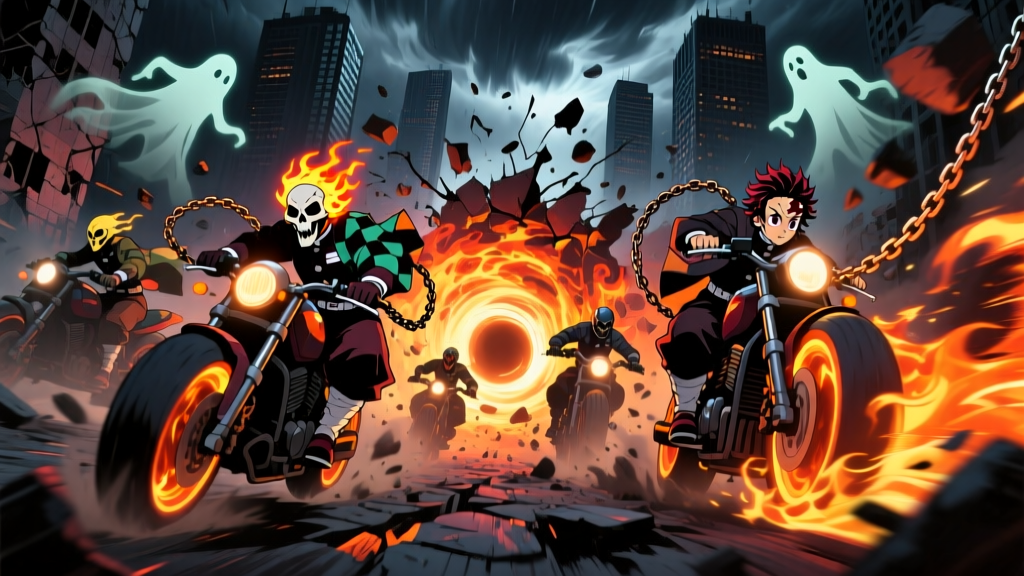
The flaming skull on the cover isn't just a marketing trick this time. In October 2025, Marvel Comics cracked open the supernatural vault and dumped every Ghost Rider it could find into one five-issue series. Spirits of Violence #1 doesn't ease into its premise — it throws Johnny Blaze, Danny Ketch, Robbie Reyes, Kushala, Fantasma, and Hellverine into a collision with an entity that makes the original Spirits of Vengeance look like campfire stories.
The comic dropped on October 1st with a $4.99 cover price across 32 full-color pages. Sabir Pirzada writes it. Paul Davidson handles pencils and inks. Andrew Dalhouse colors. Kendrick "Kunkka" Lim paints the main cover. And somewhere between the third page and the last panel, you realize Marvel isn't just recycling a franchise — they're trying to redefine what the Ghost Rider mythology actually means inside the broader Marvel Universe.
The Premise: A Spirit That Even Hell Didn't Plan For
Here's the setup. A new group of villains surfaces with a singular obsession: hunting down every living host connected to the Spirit of Vengeance. Not just the current riders. Not just the famous ones. Everyone. The entity pulling the strings calls itself the Spirit of Violence — a designation that sounds like a knockoff until you watch it rip through the story's first act with the kind of menace that makes Zarathos look restrained.
Pirzada's approach is deliberate. The opening issues establish that this entity doesn't just want to destroy the Ghost Riders. It wants to consume the concept of vengeance itself, absorbing each Spirit of Vengeance fragment and twisting it into something unrecognizable. The stakes escalate from personal survival to existential threat within roughly twenty pages — which, for a debut issue, is efficient storytelling.
The villains working under the Spirit of Violence aren't throwaway henchmen either. They're drawn with specific motivations and tactical intelligence, which matters because the series needs credible antagonists to justify assembling six supernatural heavyweights in one book.
The Roster: Six Riders, Zero Redundancy
One legitimate question going into this series: why does Marvel need six Ghost Rider-adjacent characters in one comic? The answer, at least based on what issue #1 establishes, is that each rider serves a distinct narrative function rather than just adding firepower.
Johnny Blaze
The original. The one who made the deal with Mephisto. Blaze carries the weight of decades of continuity, and Pirzada uses him as the series' anchor — the veteran who recognizes that the Spirit of Violence represents something the Ghost Rider mythos hasn't encountered before. His hellfire burns the familiar orange-red, and his motorcycle remains the iconic flaming chopper that defines the franchise.
Danny Ketch and the Barbara Problem
This is where the story gets personal. Danny Ketch, the second Ghost Rider whose 1990 debut sold millions and briefly made the character a pop culture phenomenon, faces a threat tied directly to his bloodline. Barbara Ketch, Danny's sister, becomes the host for the Spirit of Violence itself. That's not a spoiler — Marvel's own solicitations confirmed it before issue #1 shipped.
Barbara's history in the comics stretches back to Danny's original series. She was killed early in his run as Ghost Rider, a death that fueled his transformation and his guilt. Bringing her back as the vessel for a predatory spirit is a move that carries genuine emotional weight for anyone who read the Howard Mackie era. It also creates an immediate conflict: Danny can't just destroy the enemy because the enemy is wearing his dead sister's face.
Robbie Reyes, Kushala, Fantasma, and Hellverine
Robbie Reyes, the Ghost Rider introduced in 2014 who drives a hellfire-charged muscle car instead of a motorcycle, brings a younger energy and a different cultural texture to the roster. Kushala, the Spirit Rider from the 1800s Apache lineage, connects the franchise to indigenous mythology and expands the supernatural framework beyond the typical Judeo-Christian hell imagery. Fantasma, a more recent addition, operates in the liminal space between ghost and rider. Hellverine — the demon-possessed fusion that debuted in his own 2024 series — rounds out the team with a brutality that makes even Blaze look measured.
The challenge Pirzada faces across five issues is giving each character meaningful screen time without the book becoming a rotating carousel of action beats. Issue #1 manages it by focusing the initial confrontation through Blaze and Ketch, letting the others arrive as the scope of the threat becomes clear.
The Creative Team Behind the Flames
Sabir Pirzada isn't new to Marvel's supernatural corner. He's written for the publisher across multiple genres, but Spirits of Violence represents his most ambitious assignment in the horror-action space. His scripting here balances exposition with momentum — the issue doesn't drown in backstory, but it also doesn't assume readers know every Ghost Rider's publication history.
Paul Davidson on pencils and inks brings a style that sits somewhere between classic horror illustration and modern superhero dynamism. His figures are muscular and expressive without drifting into exaggerated anatomy. The hellfire effects — a critical element in any Ghost Rider book — are rendered with enough variation that each rider's flames read as distinct. Blaze burns hot orange. Ketch's blue-white flame gets its own visual treatment. Kushala's fire carries a different texture entirely, tied to her spiritual lineage rather than infernal origin.
Andrew Dalhouse on colors does the heavy lifting that sells the supernatural atmosphere. The palette leans hard into deep crimsons, shadow blacks, and spirit blues — which happens to match the thematic identity of the series almost too perfectly. Dark backgrounds dominate, with hellfire providing the primary light sources in most panels. It's a look that works on the page and would translate effectively to screen, should Marvel's entertainment division ever decide to adapt this particular corner of the mythology.
"Pirzada calls this series an exploration of what happens when vengeance stops being personal and starts being consumed. It's not just about the Ghost Riders fighting a villain — it's about an entity that feeds on the very impulse that created them."
— Marvel Comics solicitation materials, 2025
Art Style: Where Horror Meets Superhero Physics
Davidson's interior art occupies a specific niche in contemporary comics: it's grounded enough to sell the horror elements — shadowed corridors, distorted spirit forms, visceral action — while still delivering the kinetic superhero layouts that Marvel's house style demands. You won't find the abstract panel-breaking experiments of a Bill Sienkiewicz here, but you also won't find the flat, assembly-line superhero art that sometimes fills mid-tier Marvel books.
The Spirit of Violence's design deserves specific mention. Rather than another flaming skull variant, the entity manifests as something more abstract — a coalescing darkness with suggestion of form rather than fixed anatomy. When it possesses Barbara Ketch, the visual shifts: her body becomes a conduit, with flame patterns that look wrong in a way that's genuinely unsettling. The fire doesn't burn outward like a Ghost Rider's transformation. It pulls inward, as if consuming the host from the inside.
Panel composition varies across the issue. Action sequences use dynamic, overlapping layouts with figures breaking panel borders. Quiet character moments — particularly a scene between Blaze and Ketch discussing the nature of their shared curse — use tighter, more claustrophobic framing that emphasizes the weight of their history.
| Detail | Specification |
|---|---|
| Publisher | Marvel Comics |
| Release Date | October 1, 2025 |
| Series Format | 5-issue limited series (2025–2026) |
| Writer | Sabir Pirzada |
| Artist (Pencils/Inks) | Paul Davidson |
| Colorist | Andrew Dalhouse |
| Main Cover | Kendrick "Kunkka" Lim |
| Variant Covers | Peach Momoko, E.M. Gist (1:50 incentive), Ryan Hotz |
| Page Count / Price | 32 pages / $4.99 |
| Content Rating | T+ (Teen and Up) |
| Critical Reception | 6.4/10 average (Comic Book RoundUp, 2025) |
Collector's Perspective: What This Issue Is Actually Worth
Let's talk numbers, because the collector market for Spirits of Violence #1 has already started stratifying in ways that matter.
The standard A-cover by Kunkka sits at modest collector values — roughly $2 in mid-grade condition, climbing to $5 in near-mint. This is a modern Marvel book with wide distribution, so the standard cover isn't where serious collectors focus. The Peach Momoko variant, as is typical with her covers, commands a premium. Momoko's distinctive Japanese-influenced illustration style has become one of the most sought-after variant treatments in the current market, and her Ghost Rider work here doesn't disappoint.
The E.M. Gist 1:50 incentive variant represents the highest collector ceiling for this issue. Gist's horror-oriented style — he's known for work on Spawn and other dark properties — aligns perfectly with the book's content, and the 1:50 ratio means shops had to order fifty copies of the standard cover to unlock a single Gist variant. That scarcity, combined with the cover's aesthetic appeal, pushes values higher in graded copies. CGC has already begun cataloging graded submissions, with the Gist variant receiving its own population report entry.
The Ryan Hotz variant sits in the middle tier — more accessible than the Gist, but still carrying a premium over the standard cover. For collectors building a complete set of Spirits of Violence variants across all five issues, the Hotz covers form a cohesive visual run.
Whether this book appreciates long-term depends on two factors: whether the series' story becomes a defining Ghost Rider arc referenced in future media, and whether any of these characters appear in Marvel's upcoming film or streaming slate. The Ghost Rider franchise has been circling live-action adaptation for years, and a strong Spirits of Violence run would be natural source material.
Where This Sits in the Horror-Action Comic Landscape
Ghost Rider occupies an unusual position in Marvel's lineup. The character has never sustained a long-running monthly series the way Spider-Man or the X-Men have, but every revival generates significant initial interest. The original Ghost Rider (Johnny Blaze) debuted in Marvel Spotlight #5 in 1972, created by Roy Thomas, Gary Friedrich, and Mike Ploog. Danny Ketch's 1990 series by Howard Mackie and Javier Saltares became a genuine sales phenomenon during the speculator boom, regularly moving over 200,000 copies per issue at its peak.
Spirits of Violence lands in a market where horror-action comics have found renewed commercial viability. Image's Something Is Killing the Children proved that horror comics can sustain ongoing series with strong direct market and bookstore sales. Marvel's own Werewolf by Night revivals and the Hellverine solo series demonstrated that the publisher's supernatural characters can move units when paired with the right creative teams.
What distinguishes Spirits of Violence from straightforward horror comics is the action-superhero framework. This isn't atmospheric slow-burn horror in the vein of Hill House or Gideon Falls. It's explosive, supernatural action with horror elements woven into the premise. The Spirit of Violence is frightening in concept — an entity that consumes vengeance itself — but the execution involves flaming motorcycles, hellfire chains, and six supernatural warriors throwing down against waves of enemies. It's closer to Constantine meets Mad Max than it is to literary horror.
The series also arrives at a moment when Marvel's supernatural universe has been quietly expanding. The Spirits of Vengeance concept — the idea that the Ghost Rider's power comes from fragmented divine wrath rather than simple demonic possession — was developed across multiple series over the past decade. Spirits of Violence builds directly on that mythology, treating the various Ghost Riders not as separate characters who happen to share a power source, but as pieces of a larger supernatural architecture that's now under direct attack.
Critical Response: Divided Rooms
The issue received a 6.4 out of 10 average on Comic Book RoundUp, which aggregates both critic and user scores. That middling number conceals a more polarized response than the average suggests.
Positive reviews praised the ambitious roster and the Barbara Ketch twist. AIPT's review highlighted the series' attempt to honor the Ghost Riders' shared history while introducing a threat that feels genuinely new to the mythology. The art received consistent praise across most reviews, with Davidson's hellfire effects and Dalhouse's color palette earning specific recognition.
Critical reviews pointed to the familiar problem of limited series: too many characters, not enough pages. Some reviewers argued that five issues isn't sufficient to service six major characters plus a new villain, and that the story would have benefited from either reducing the roster or expanding the page count. The Comics Beat described the series as a "bait-and-switch," suggesting that the marketing promised a Ghost Rider team book while the actual narrative focused heavily on specific characters at the expense of others.
Fan reception on platforms like Reddit's r/GhostRider community ran warmer than critical reception, with long-time franchise readers appreciating the deep cuts into Ghost Rider lore — particularly the Barbara Ketch resurrection and the exploration of how different Spirits of Vengeance interact with their hosts.
Frequently Asked Questions
Is Spirits of Violence #1 a good starting point for new Ghost Rider readers?
It depends on your tolerance for backstory. Pirzada provides enough context for each character that new readers can follow the plot, but the emotional impact of the Barbara Ketch subplot and the significance of assembling multiple Ghost Riders hits harder if you have familiarity with Danny Ketch's original 1990s series. If you want a single-issue entry point, Blaze's solo stories or Robbie Reyes's 2014 debut are more self-contained.
How does Spirits of Violence connect to previous Ghost Rider series?
The series builds on the "Spirits of Vengeance" mythology developed across the past decade of Marvel's supernatural titles. The concept — that Ghost Rider powers derive from fragments of a divine weapon of wrath rather than purely demonic sources — comes from Jason Aaron's and Ed Brisson's runs on the character. Spirits of Violence treats those fragments as targets: the villain wants to consume them all.
Will Robbie Reyes appear throughout the entire five-issue run?
Marvel's solicitations for issues #1 through #5 list Robbie Reyes among the featured characters, and promotional art consistently includes him. However, critical reviews noted that some characters receive more page time than others across the series. Reyes appears, but his role is smaller than Blaze's or Ketch's.
What is the Spirit of Violence, exactly?
Without spoiling the full reveal across the series: the Spirit of Violence is presented as an entity that exists alongside — but outside — the traditional Spirits of Vengeance. Where the Spirits of Vengeance channel divine wrath, the Spirit of Violence channels something older and less purposeful. Its possession of Barbara Ketch gives it a personal connection to the Ghost Rider legacy that goes beyond generic villainy.
Which variant cover is worth buying for collectors?
The Peach Momoko variant offers the strongest combination of aesthetic appeal and market demand. The E.M. Gist 1:50 incentive is the scarcity play — harder to find, more expensive in graded condition, and a better long-term hold if you believe in the series' lasting significance. The standard Kunkka cover is perfectly fine for readers who just want the story.
The Franchise's Next Chapter
Five issues. That's what Marvel allocated for this particular confrontation. Whether Spirits of Violence becomes a recurring franchise or a one-shot experiment depends on sales figures and the creative team's willingness to continue. Pirzada has described the series as a complete story rather than a prologue, which suggests the five-issue arc will resolve its central conflict — even if it leaves threads for future writers to pull.
For Ghost Rider fans who've been waiting since the last solo series ended, Spirits of Violence represents the most concentrated dose of supernatural Marvel action the character has seen in recent years. It's imperfect — the page count fights against the roster size, and some characters get shortchanged — but the ambition is real. Barbara Ketch as the Spirit of Violence is a concept with genuine dramatic legs, and the visual identity Davidson and Dalhouse establish gives the series a look that separates it from every Ghost Rider book that came before.
The flames aren't going out anytime soon. They're just burning a different color now.