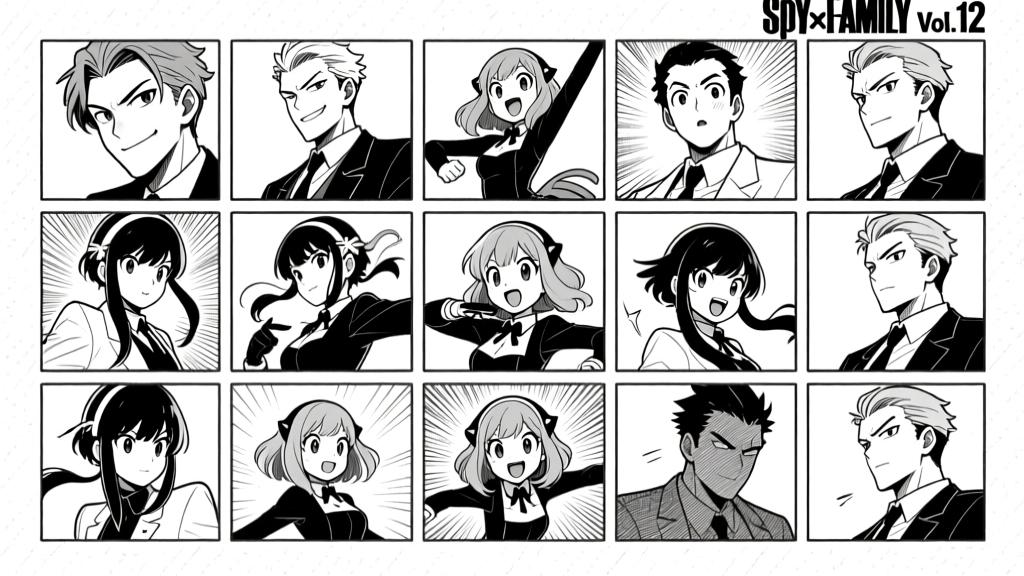
“Wait—so the whole ‘Anya’s psychic scream’ bit in Chapter 89 isn’t a plot beat? It’s a *laugh track cue*?”
Yeah. I said it. And no, I’m not joking—or at least, I’m only half-joking, which is exactly how Endo wants you to feel.
Let’s cut through the polite anime-manga discourse: Volumes 12–15 of Spy x Family aren’t just *funny*. They’re structurally engineered like a 22-minute network sitcom—complete with cold opens, B-plots that land on the same beat every time, and background gags so consistent they qualify as recurring characters. Not “kinda like” a sitcom. Like a sitcom. The kind where the laugh track is silent, but your brain supplies it anyway.
It starts with the panels—and no, I don’t mean “big splash page = drama.” I mean the grids.
Flip to Chapter 87, page 14—the one where Loid “takes a coffee break” in the middle of tailing a target. You know the one: he’s perched on a park bench, steam rising from a mug, eyes dead ahead… while behind him, in a tiny 2×2 inset grid, Anya’s doing interpretive dance with a squirrel she’s convinced is “a spy squirrel (NOT REAL).” Then—cut—back to Loid, now holding the mug sideways, steam curling in the wrong direction. That’s not a gag. That’s a cutaway. Like when Kramer stumbles into Jerry’s apartment mid-monologue on Seinfeld. Same timing. Same visual reset. Same deliberate, almost mechanical rhythm.
Endo confirmed this in Animedia #321 (May 2023): “I rewatched Friends and The Office while drafting Vol. 12. Not for jokes—I studied the breathing room. Where the camera holds. Where the silence lands. Manga doesn’t have a laugh track, so the panel spacing *has* to do the work.”
So what does that mean for you, reader—who just got Volume 12 as a birthday gift and is already sweating over whether “Yor’s grocery list” is foreshadowing or just… groceries?
Here’s your anti-overthinker’s cheat sheet:
- When you see three identical-sized horizontal panels stacked top-to-bottom (especially with repeating background elements—e.g., the same potted plant, same clock, same suspiciously still pigeon), treat it like a scene tag: “This is the punchline. Pause here. Breathe. Maybe chuckle. Then turn the page.” (See Vol. 13, Ch. 92, pp. 6–8: Yor’s “casual” attempt to fold laundry while hiding a stun gun in her sleeve. Each panel shows the same laundry basket, same folded shirt, same increasingly strained smile—then the fourth panel reveals the shirt has *absorbed the stun gun’s charge* and is now gently levitating.)
- Recurring background gags aren’t Easter eggs. They’re running gags, and they follow 4-koma logic—not in layout, but in function. Remember the “crying cat” in the corner of Eden Academy’s hallway? It appears in Vol. 12 Ch. 85, Vol. 13 Ch. 91, Vol. 14 Ch. 97… always in the same spot, always with slightly different tears (raindrop-shaped in Ch. 85, heart-shaped in Ch. 91, then inexplicably wearing tiny sunglasses in Ch. 97). In classic 4-koma, that’s the “boke” character—the straight-man foil who exists purely to react. Here, it’s the manga’s version of a studio audience member who *always* laughs at the same line.
- If Anya’s thoughts appear in ALL CAPS with jagged borders—and especially if there’s a tiny “???” floating beside her head in the next panel—that’s not exposition. That’s the callback. Read it like a sitcom’s “previously on…” recap: it’s not advancing plot, it’s resetting tone.
I remember watching Chapter 89—the “Psychic Scream Incident”—on a train, and realizing halfway through that I’d subconsciously started counting beats between Anya’s inner monologue and the actual dialogue. Three panels after her thought bubble: Yor blinks. Four panels: Loid’s eyebrow twitches. Five: the squirrel from Chapter 87 scurries across the gutter. It wasn’t organic. It was choreographed. And it worked because it felt familiar, not formulaic.
That’s the real secret Endo’s hiding in plain sight: he’s not borrowing sitcoms’ jokes. He’s borrowing their trust. Trust that the audience knows when to lean in, when to exhale, when to let the absurdity hang in the air like Loid’s perpetually tilted coffee mug. You don’t need to decode every reference. You just need to stop treating these volumes like a mystery novel—and start reading them like you’re settling onto the couch with popcorn, waiting for the theme music to kick in.
(Spoiler: the theme music is Anya humming off-key while drawing stick-figure spies in the margin of her math workbook. Turn the page. It’s already playing.)