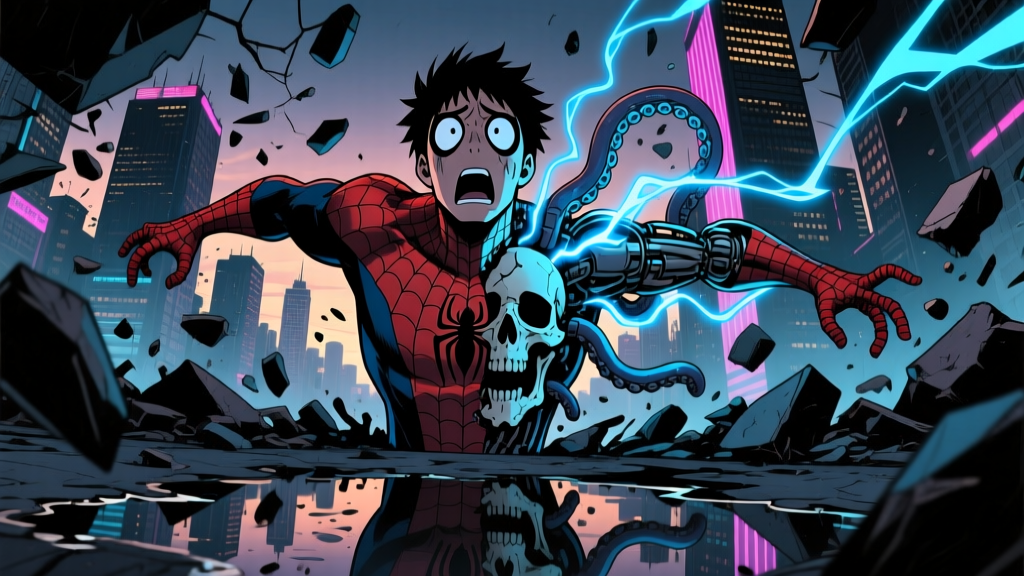
Picture this: you have spent your entire criminal career being known by one thing — four mechanical arms bolted to a harness, a bulbous cranium, and a hatred for a teenager in spandex. Then, through a body-swap gambit that would make any neurosurgeon weep, you inherit that teenager's life. His body. His powers. His reputation. You put on his mask and tell yourself you are now superior to everything he ever was.
That is exactly the position Otto Octavius found himself in when he took over Peter Parker's body in Amazing Spider-Man #700 (December 2012). For roughly ten months of publication time, Otto strutted around New York as the "Superior Spider-Man," convinced he had cracked the code that Peter never could. He built an empire. He founded Parker Industries. He dated Anna Maria Marconi. He even roughed up J. Jonah Jameson's son at a crime scene, something the old Peter would never have dreamed of.
And then Spider-Man 2099 showed up and tore the whole facade apart.
The "Unmasked" storyline — running through Superior Spider-Man #17–19 (cover-dated September to October 2013) — is the pivotal arc of the entire Superior era. Plotted by Dan Slott, scripted by Christos N. Gage, and illustrated by Will Conrad and Ryan Stegman, these three issues did what no other storyline in the run attempted: they forced Otto Octavius to look in the mirror and confront the one question he had been dodging since issue #1. Who are you, really?
"You think putting on his face makes you him? You're wearing a dead man's skin, Octavius. And everyone who ever loved him is going to find out."
— Miguel O'Hara, Spider-Man 2099, Superior Spider-Man #18
The Road to Unraveling: What Made Otto So Sure of Himself
To understand why the unmasking hit so hard, you need to rewind to the beginning of the Superior Spider-Man's tenure. When Otto Octavius — terminally ill, his biological body failing — executed the "Octobot" mind-swap in Amazing Spider-Man #700, he left Peter Parker to die inside the crumbling shell of Doctor Octopus. Peter did die, in a sense. His consciousness was erased (or so everyone thought). Otto inherited the wall-crawling, the spider-sense, the proportional strength, and the guilt. That last one was the surprise package.
Peter's dying memories flooded Otto's mind with decades of responsibility-driven choices. Uncle Ben. Gwen Stacy. The thousands of lives saved. And Otto, ever the pragmatist, decided that with his superior intellect married to Peter's moral compass, he could do the job better. Not just as well. Better.
For the first sixteen issues of Superior Spider-Man, he made a compelling case.
- He neutralized the Sinister Six's remaining members with tactical precision Peter had never mustered.
- He founded Parker Industries, turning Peter's perpetually broke existence into a legitimate tech startup.
- He created the Spider-Bots, a surveillance network that covered Manhattan and cut crime response times dramatically.
- He killed Massacre, crossing the moral line Peter refused to cross, and publicly argued that some threats demanded permanent solutions.
The problem with being superior, though, is that superiority is a moving target. You can always be better at the job and still be worse at being the person behind the mask.
A Time-Displaced Spider: How Miguel O'Hara Got Dragged Into It
Miguel O'Hara, the Spider-Man of the year 2099, had been stuck in the present-day Marvel Universe since the events of Spider-Man: Edge of Spider-Verse and his own ongoing temporal displacement storyline. Under the alias "Michael O'Mara," he had been working at Horizon Labs — the same research facility where Otto (as Peter Parker) had built his tech empire during the "Big Time" era of Amazing Spider-Man.
Miguel had a unique vantage point that no other character in the book possessed. He came from a future where Peter Parker's legacy was cemented. The 2099 timeline treated Spider-Man as a foundational myth, a symbol that had endured for nearly a century. So when Miguel watched the present-day Spider-Man behave with increasing ruthlessness — deploying an army of robotic sentinels, brutalizing criminals beyond what the job required, dismissing the concerns of allies — something did not add up.
The catalyst for the "Unmasked" arc was a temporal crisis. Tyler Stone (also known as Tiberius Stone), the founder of Alchemax — Miguel's former employer and the megacorporation that would one day dominate the 2099 landscape — was being erased from the timeline. If Stone vanished from history, Alchemax would never exist, and the entire future Miguel came from would collapse like a house of cards.
Miguel needed help. Otto, operating as Spider-Man, had the resources at Horizon Labs to address the temporal anomaly. But collaboration between the two Spider-Men was never going to be smooth. Otto treated Miguel with the same condescension he extended to everyone — as an intellectual inferior who should be grateful for his attention. Miguel, who had spent years watching Spider-Man's legend grow from the outside, found this version of the hero insufferable.
The Moment Everything Cracked Open
Issue #17 opens with the temporal crisis escalating. Stone's erasure from reality creates visible ripples — objects associated with Alchemax's history flicker in and out of existence around Horizon Labs. Miguel, in his Spider-Man 2099 costume, is racing against a clock that literally rewrites itself every few minutes. He needs Otto's help. Otto, predictably, is more interested in his own agenda.
Artist Will Conrad renders the tension between the two Spider-Men with a visual language that makes them feel like mirror images gone wrong. Otto's Superior Spider-Man costume — black and red, angular, militaristic — stands in sharp contrast to Miguel's blue-and-red 2099 suit, which reads as sleek and forward-looking. Both are Spider-Men. Neither trusts the other.
The confrontation escalates in issue #18, which shifts the battle from the temporal anomaly to the question of identity itself. As the two work together (however reluctantly) to stabilize the Stone paradox, Miguel's 2099-era scanning technology picks up biometric data that does not match anything in the Spider-Man records he carries from the future. Otto's heartbeat, his neural patterns, his DNA signature as filtered through Peter Parker's body — they are all wrong.
Miguel confronts Otto directly. And here is where Christos Gage's scripting earns its weight. The unmasking is not a punch-fest resolution. It is a conversation, ugly and raw, between two people wearing variations of the same mask.
Miguel: "Your biometrics don't match. Not even close. I've got eighty years of Spider-Man data, and none of it lines up with you."
Otto: "Your data is flawed. Eighty years of degradation, copy errors, folklore."
Miguel: "I'm looking at you right now. Your posture, your cadence, the way you throw a punch — you fight like a man who learned to fight from someone else's memories. Not like someone who grew up doing it."
Otto: "I am superior in every way that matters."
Miguel: "That word again. Superior. You keep using that word."
By the end of issue #18, the secret is no longer contained. Miguel knows — and he makes sure that at least some of Otto's allies know — that the man behind the Superior Spider-Man's mask is not Peter Parker. He is Otto Octavius. Doctor Octopus. One of Spider-Man's oldest, deadliest enemies, wearing the hero's face like a trophy.
Ryan Stegman's Visual Storytelling in the Climax
Ryan Stegman takes over art duties for issues #18–19, and his style is built for emotional wreckage. Where Conrad's linework on #17 is precise and controlled, Stegman's panels are jagged, explosive, and saturated with shadow. The unmasking scene itself is rendered in a sequence of tight close-ups — Miguel's eyes narrowing behind his mask, Otto's jaw clenching, the moment of recognition that plays out not as a dramatic face-reveal but as a data readout on a 2099 wrist-display. The audience already knows the truth. The characters finally catching up to it is what makes the sequence land.
What Happened After the Secret Got Out
The fallout from the unmasking was immediate and multi-layered. This was not a case where a villain's identity is revealed to the public and the story moves on. The unmasking of Otto Octavius within the Superior Spider-Man narrative had consequences that touched every relationship Otto had built during his tenure.
Anna Maria Marconi
Anna Maria, a brilliant doctoral student whom Otto had been dating as Peter Parker, represented the closest thing Otto had to a genuine human connection in his new life. When the truth about Otto's identity surfaced, Anna Maria was forced to reckon with a deeply uncomfortable reality: the man she had fallen for was, on a biological level, the same Peter Parker she had always known, but on a psychological level, someone else entirely. Someone who had stolen a life. Their relationship did not end with a dramatic breakup scene — it fractured slowly, through missed calls, averted eyes, and the quiet horror of realizing you might be in love with a ghost.
Horizon Labs and Professional Reputation
At Horizon Labs, Otto had been operating as Peter Parker the scientist — a respected, if occasionally insufferable, researcher. The unmasking arc accelerated the erosion of his professional standing. His colleagues had already noticed behavioral shifts: Peter used to be warm, self-deprecating, quick to credit others. The "new" Peter was imperious, dismissive, and prone to monologuing about intellectual superiority. Once the temporal crisis at Horizon Labs was resolved, the facility's future became uncertain — tying up a long-running thread from the "Big Time" era of Amazing Spider-Man and effectively closing the book on the workplace that had defined Peter's civilian life for years.
The Spider-Bots and Surveillance State
Otto's network of Spider-Bots, once heralded as a breakthrough in crime prevention, became a symbol of his overreach. After the unmasking, several of the bots were compromised, their security protocols exploited by adversaries who now understood that the "Spider-Man" running them was not the hero they assumed. The Green Goblin, who had been quietly rebuilding his criminal empire throughout the Superior run, used this vulnerability to devastating effect in the issues that followed.
Two Spider-Men, Two Philosophies: Otto vs. Miguel at a Glance
The "Unmasked" arc works because Otto and Miguel are not just different characters — they represent two fundamentally opposed ideas about what Spider-Man is supposed to be. Here is how they stack up across the dimensions that matter most in this storyline:
| Dimension | Otto Octavius (Superior Spider-Man) | Miguel O'Hara (Spider-Man 2099) |
|---|---|---|
| Source of Powers | Stolen — inhabits Peter Parker's body via mind-swap | Earned — genetic splicing accident (50% spider DNA) |
| View on Responsibility | A metric to optimize; problems to solve efficiently | A personal burden carried because no one else will |
| Attitude Toward Killing | Acceptable for irredeemable threats (Massacre, James Jolson) | Avoided whenever possible; crossed the line only under extreme duress |
| Technology Philosophy | Surveillance and control — Spider-Bots, Parker Industries security grid | Augmentation and mobility — talons, accelerated vision, glide cape |
| Relationship to Peter Parker | Replaced him; considers himself an upgrade | Reveres his legacy; sees him as the standard to live up to |
| Greatest Weakness | Arrogance — believes he has transcended his villainous past | Isolation — displaced from his era, no support network |
| Resolution in the Arc | Forced to confront that he is an imposter, not a successor | Proves that legacy is not about the mask but the person inside it |
What makes this comparison sting for Otto is that Miguel is, in almost every measurable way, the kind of Spider-Man that Otto only pretends to be. Miguel did not steal his powers. He did not displace anyone. He carries the weight of Peter Parker's legacy not as a costume to wear but as an ideal to aspire toward. And he does it alone, ripped from his own century, with no one to validate his claim to the name.
Doctor Octopus in the Mirror: Otto's Identity Crisis
Here is the thing about identity crises in superhero comics: they are almost always framed as external conflicts. A villain discovers the hero's secret identity. The hero must deal with the consequences. The tension comes from the outside in.
The "Unmasked" arc inverts that formula entirely. Otto's crisis comes from the inside out. Miguel does not simply expose Otto to the world — he exposes Otto to himself.
Throughout the Superior Spider-Man run, Otto had maintained a carefully constructed narrative: he was not Doctor Octopus anymore. He had evolved. The memories Peter left behind had changed him. He was a hero now, demonstrably better at the job than Peter ever was. Crime rates were down. The Sinister Six was dismantled. His technology was saving lives at scale.
Miguel's unmasking stripped away that narrative layer by layer. The biometric data was incontrovertible. Otto was not Peter Parker. He was a man who had stolen Peter Parker's body, and every accomplishment he had achieved as "Spider-Man" was built on a foundation of theft. No matter how many people he saved, the act of salvation was performed in a skin that did not belong to him.
Issue #19 drives this point home with a sequence that ranks among the most psychologically honest moments in the entire Superior run. Otto, alone after the temporal crisis is resolved, stares at his reflection — Peter Parker's face staring back — and for the first time, he sees it for what it is. Not his face. Not his life. A borrowed existence with an expiration date that was never his to set.
The deeper wound: Otto had always defined himself against Peter Parker. As Doctor Octopus, his entire identity was built on being Spider-Man's intellectual superior — the man who could outthink the web-slinger at every turn. When he became Spider-Man, he assumed the rivalry was resolved. He had won. But Miguel's unmasking reframed the question. It was never about who was the better Spider-Man. It was about who had the right to be Spider-Man. And on that measure, Otto came up empty.
The Paradox of Improvement
There is a bitter irony threaded through the "Unmasked" arc that Gage's writing leans into with full force. The very qualities that made Otto a better Spider-Man on paper — his ruthlessness, his strategic brilliance, his willingness to cross lines — are the same qualities that make him fundamentally unfit for the role. Peter Parker was Spider-Man because Peter Parker would never consider himself superior to anyone. That humility, that bone-deep awareness of his own fallibility, was the actual superpower. Not the wall-crawling. Not the spider-sense. The ability to carry the weight of the mask without letting it consume the person underneath.
Otto, confronted with this truth, does what Otto always does when confronted with uncomfortable realities: he rationalizes. He tells himself the unmasking changes nothing. The work continues. He is still the Superior Spider-Man. The mask is still his.
But it is not. And everyone reading knows it.
How Three Issues Set the Stage for the End of an Era
The "Unmasked" arc did not end the Superior Spider-Man series — that would come later, in the "Superior Spider-Man Must Die" storyline that ran through issues #30–33 and culminated in the return of Peter Parker. But it planted every seed that the finale would harvest.
After the unmasking, the narrative shifted in three significant ways:
- Otto's confidence cracked. He continued to operate as the Superior Spider-Man, but the bravado was thinner. His decisions became more erratic — more aggressive, as though he was trying to prove something to himself rather than to the world. This volatility directly fed into his later confrontations with the Green Goblin, where his overconfidence led to catastrophic failures.
- Peter Parker's consciousness resurfaced. The unmasking arc reinforced the narrative thread that Peter was not fully gone. Fragments of his awareness had been bleeding through Otto's control since the body swap, and the psychological destabilization caused by the unmasking accelerated that process. By the time the "Superior Spider-Man Must Die" arc arrived, Peter was actively fighting to reclaim his body from within.
- The Green Goblin exploited the chaos. Norman Osborn, who had been operating in the shadows throughout the Superior run, recognized that a Spider-Man whose identity was in flux was a Spider-Man who could be broken. The Goblin's assault on Otto's network of allies and infrastructure was made possible by the fractures that the unmasking arc had widened.
Dan Slott has stated in interviews that the Superior Spider-Man arc was always intended as a story about Otto Octavius learning what Peter Parker already knew — that being Spider-Man is not about power, strategy, or efficiency. It is about sacrifice. The "Unmasked" arc is where Otto learned that lesson's first clause: you cannot sacrifice what is not yours to give.
"The entire Superior saga was, at its core, a villain origin story told in reverse. Otto started as a monster, became a hero, and then had to reckon with the fact that his heroism was built on the same selfishness that made him a monster in the first place."
— Dan Slott, speaking to Comic Book Resources (2014)
Where to Read the Unmasked Arc
For readers who want to experience the arc firsthand, the three issues of the "Unmasked" storyline have been collected in several formats over the years:
| Collection | Issues Included | Format | Year |
|---|---|---|---|
| Superior Spider-Man Vol. 3: No Escape | #14–19 | Trade Paperback | 2014 |
| Superior Spider-Man: The Complete Collection Vol. 2 | #14–19 + tie-ins | Trade Paperback | 2018 |
| Superior Spider-Man Omnibus Vol. 1 | #1–19 + ASM #700 + extras | Oversized Hardcover | 2023 |
The Omnibus is the premium option if you want the complete Superior experience through the unmasking, including the lead-in issues that establish Otto's increasingly strained grip on Peter's life. The Complete Collection Vol. 2 is the best value pick, bundling the No Escape arc alongside related tie-in material for context.
Thirteen Years Later, This Arc Still Hits Different
There have been plenty of "villain takes over the hero's life" storylines in superhero comics. Venom as Spider-Man. Bucky as Captain America. Lex Luthor as Superman. Most of them are entertaining. Very few of them are honest.
What separates the "Unmasked" arc from the pack is its refusal to let Otto off the hook. The story does not argue that Otto became a better person. It does not argue that his tenure as Spider-Man was a net positive. What it argues, with surgical precision, is that identity is not a costume you can put on. You can wear the mask, adopt the mannerisms, replicate the powers, and even achieve better results than the person who wore it before you. But none of that makes you them. And pretending otherwise is not heroism — it is the most elaborate form of theft imaginable.
Miguel O'Hara understood this instinctively. He had spent his entire career as Spider-Man 2099 operating in the shadow of a legend he could never fully embody — and he was fine with that. He did not need to be the original Spider-Man. He needed to be his own version of the ideal. That is the distinction that Otto could not see until someone held up a mirror and forced him to look.
The "Unmasked" arc is not the end of Otto Octavius's story. He would go on to become the Superior Octopus, join the Avengers, face down the Inheritors, and eventually find a kind of peace in his own body during the Superior Spider-Man revival. But the three-issue run where Spider-Man 2099 ripped away his borrowed identity remains the emotional center of everything Otto became afterward. It was the moment the villain realized that the hardest person to defeat was not the hero whose life he stole, but the truth about himself he had been running from all along.
Frequently Asked Questions
In which issues does Spider-Man 2099 unmask the Superior Spider-Man?
The unmasking plays out across Superior Spider-Man #17–19, published by Marvel Comics in 2013. The biometric confrontation between Miguel O'Hara and Otto Octavius peaks in issue #18, with the emotional aftermath carrying through issue #19.
Who wrote and drew the "Unmasked" storyline?
The arc was plotted by Dan Slott (the series architect) and scripted by Christos N. Gage. Will Conrad provided art for issue #17, with Ryan Stegman handling issues #18–19. Stegman's gritty, shadow-heavy style became synonymous with the arc's emotional intensity.
How did Miguel O'Hara discover that Otto was not Peter Parker?
Miguel used 2099-era biometric scanning technology embedded in his suit. The scans compared Otto's vital signs, neural patterns, and DNA markers against decades of Spider-Man data from the future. Nothing matched — the readings pointed to an entirely different person inhabiting Peter Parker's body.
Did the unmasking lead to Otto losing his role as Spider-Man immediately?
No. Otto continued as the Superior Spider-Man for over a dozen issues after the unmasking. However, the arc marked the beginning of his unraveling. His confidence was shaken, his decisions grew more volatile, and Peter Parker's consciousness began fighting back with increasing strength, ultimately leading to the "Superior Spider-Man Must Die" finale.
Is the "Unmasked" arc collected in a trade paperback?
Yes. The arc is collected in Superior Spider-Man Vol. 3: No Escape (TPB, 2014), which includes issues #14–19. It is also available in Superior Spider-Man: The Complete Collection Vol. 2 (2018) and the Superior Spider-Man Omnibus Vol. 1 (2023).
What happened to the Tiberius/Tyler Stone temporal crisis from the arc?
The Stone paradox was resolved by the end of issue #19, stabilizing the timeline and preserving Alchemax's existence in the 2099 future. The resolution also effectively closed the book on Horizon Labs as a significant Spider-Man location, tying up a thread from the "Big Time" era of Amazing Spider-Man.
Does Otto Octavius ever become Spider-Man again after the Superior era ends?
Otto resurfaces as the "Superior Octopus" during the 2018 Superior Spider-Man revival, operating in his own cloned body rather than Peter's. He later appears as the "Superior Spider-Man" once more, but with a more nuanced understanding of identity and legacy — a growth arc that traces directly back to the confrontation with Miguel in issues #17–19.