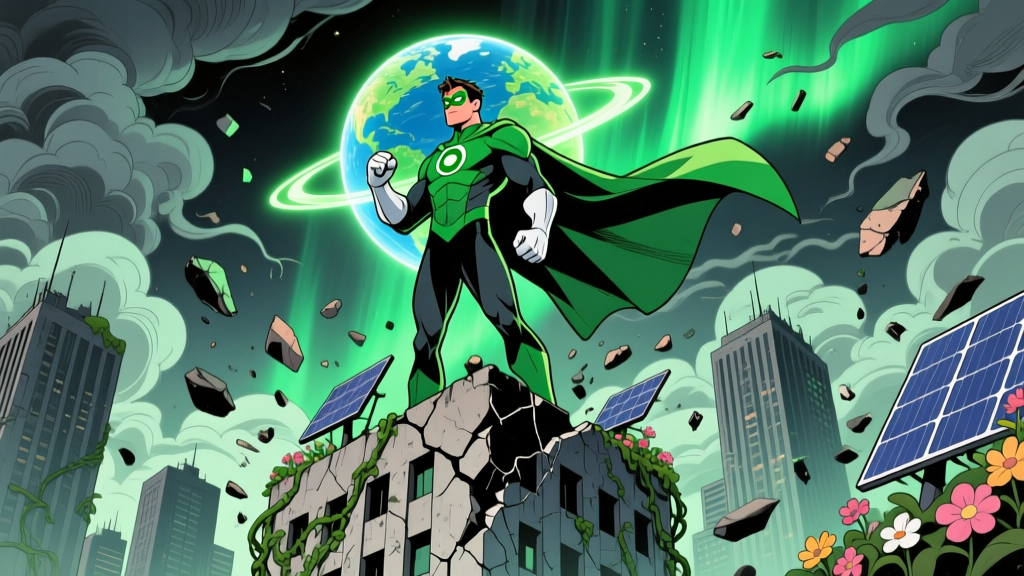
The first time I cracked open issue #1 of the 1991 Marvel run of Captain Planet and the Planeteers, the pages smelled like old newsprint and cheap four-color ink. Kwame stood in the foreground, ring raised, brown earth splitting open beneath a strip mall parking lot. It was not exactly the kind of panel you'd pin to a wall next to your Todd McFarlane Spider-Man. But it worked. It worked because the comic treated its source material with the same conviction the cartoon did—environmental destruction was the villain, and the stakes were never abstract.
Thirty-four years later, Dynamite Entertainment put a new Captain Planet #1 on shelves. The cover, painted by Mark Spears in a limited variant set, showed the five Planeteers silhouetted against a burning horizon, their rings glowing in five distinct colors. It sold out its initial print run within the first week of solicitation. Something about that surprised me—not the nostalgia, but the fact that a property built around a literal Earth elemental in a mullet could still move units in a market drowning in cape reboots.
This guide covers every Captain Planet comic published to date: the original 12-issue Marvel series, the long wilderness years, and the 2025 Dynamite revival that reintroduced Captain Planet to a readership old enough to vote and young enough to actually worry about the planet.
The Marvel Years: 12 Issues of Eco-Conscious Action (1991–1992)
Marvel Comics launched Captain Planet and the Planeteers in October 1991, roughly thirteen months after the animated series premiered on TBS. The timing was deliberate. The show had already pulled strong ratings through its first season—over 3 million households by some estimates—and Turner Broadcasting was eager to extend the brand into print. Marvel assigned the book to its younger-skewing Star Comics editorial line, the same division that handled Muppet Babies and Heathcliff, though the creative team pushed the material noticeably harder than that imprint's usual fare.
Len Kaminski wrote the series with Bob Dvorak on pencils. Kaminski had a background in both mainstream superhero work and licensed children's properties, and he brought a specific sensibility to Captain Planet: the eco-villains were never just monsters of the week. Hoggish Greedly, a bloated industrialist who literally ate profits while dumping waste into rivers, had more in common with muckraking journalism than Saturday morning cartoon logic. Verminous Skumm—a mutant rat born from toxic runoff—was gross in the way real urban blight is gross. These weren't abstract metaphors. They were recognizable problems drawn to absurd scale.
Issue Highlights from the Marvel Run
The opening arc established the Planeteers' origin cleanly: Gaia, the spirit of Earth, awakens from centuries of slumber to find the planet in crisis. She selects five teenagers from across the globe—Kwame (Africa, Earth), Wheeler (North America, Fire), Linka (Soviet Union, Wind), Gi (Asia, Water), and Ma-Ti (South America, Heart)—and gives each an elemental ring. When they combine their powers, they summon Captain Planet himself, a crystal-skinned elemental with a white mullet and the unsubtle battle cry of "By your powers combined!"
Issue #2, titled "Smog Gets In Your Eyes," tackled urban air pollution with Wheeler and Kwame trying to shut down a factory pumping carcinogens into a residential neighborhood. The story didn't pretend the solution was simple. The factory employed people. The workers had families. Kaminski wrote that tension into the script rather than around it, which gave the comic a dimension that most licensed kids' books actively avoided.
Issue #3, "The Power of Heart," centered on Ma-Ti—easily the most ridiculed Planeteer thanks to his ring's vague "Heart" power. The story gave him a solo spotlight where his empathic abilities let him communicate with displaced wildlife near a clear-cut forest. It was quiet. It was genuinely affecting. And it made the case that empathy was not a soft power when the planet was burning.
The series ran through 1992 and ended at issue #12. Marvel never collected the run in trade paperback, which over the decades turned complete sets into minor collector's items. A near-mint run of all twelve issues in CGC 9.4 or above currently trades for between $120 and $200 on the secondary market, with issue #1 accounting for roughly a third of that value.
"The Captain Planet comic was one of the few licensed books of that era that trusted its young readers to handle complexity. The villains weren't evil because they enjoyed it—they were evil because short-term profit always looks easier than stewardship." — Rob Salkowitz, comics historian and Forbes contributor, 2019
The Long Gap: Crossovers, One-Offs, and Radio Silence (1993–2024)
After Marvel's series ended, Captain Planet spent over three decades without a solo comic. The cartoon itself went through a rebranding—The New Adventures of Captain Planet moved production from DIC Entertainment to Hanna-Barbera in 1993, overhauling the animation style and recasting Kwame (LeVar Burton departed, replaced by Maurice LaMarche), and running through 1996 before cancellation. After that, the character lived mostly in reruns and nostalgia threads.
The closest the Planeteers came to a comic return during this stretch was DC Comics' Future Quest in 2016, a crossover series by Jeff Parker and Doc Shaner that blended multiple Hanna-Barbera properties—Jonny Quest, Space Ghost, the Herculoids—into a shared universe. Captain Planet appeared in a supporting capacity, not as a lead, and the crossover leaned heavily into cosmic adventure rather than environmental themes. It was fun. It was well-drawn. But it wasn't really about anything the way the original show was.
During this period, the Captain Planet Foundation—the nonprofit Barbara Pyle established in 1995—kept the brand alive through educational programs and merchandise licensing. Pyle herself publicly stated on multiple occasions that she had rejected several pitches for live-action film adaptations because studios kept trying to strip out the environmental messaging or make the Planeteers "edgier" in ways that betrayed the source material. The foundation maintained a firm hand on the IP, which meant any comic return had to clear a high bar for thematic integrity.
Why It Took So Long
The honest answer is twofold. First, the licensing landscape for children's media properties in the 1990s and early 2000s was chaotic—Turner merged with Time Warner in 1996, and Captain Planet's rights shuffled between divisions as corporate structures rearranged. Second, and arguably more important: the environmental message that made the cartoon distinctive had become politically radioactive in certain corners of American media. A comic about fighting pollution and corporate greed reads differently in 2003 than it did in 1991, depending on who's publishing it and who's buying.
That dynamic changed as climate anxiety moved from fringe concern to mainstream conversation in the 2010s and 2020s. By the time Dynamite Entertainment entered negotiations with Warner Bros. Discovery for the license, the cultural moment had circled back around to meet Captain Planet where it always stood.
Dynamite Entertainment's Captain Planet: The 2025 Revival
Dynamite announced the new Captain Planet and the Planeteers series in late 2024 as part of a broader licensing deal with Warner Bros. Discovery that also included properties like Ben 10. The book launched on April 23, 2025, with writer David Pepose and artist Eman Casallos at the helm. Jorge Sutil provided colors, and the debut issue shipped with covers by Mark Spears, Christian Ward, Ben Oliver, and a connecting variant set by Jae Lee and June Chung.
Pepose was a deliberate choice. He had written for Dynamite before, and his stated goal in pre-release interviews was clear: modernize the property without neutering what made it work. In a March 2025 conversation with Comicon.com, he described the original cartoon as something he genuinely admired rather than something he wanted to "fix." That distinction mattered. A lot of revival comics approach their source material with an attitude of corrective condescension—the implication that the old version was naive and the new version will show how it's really done. Pepose sidestepped that trap.
The New Villain: Lucian Plunder
Rather than recycling the established eco-villain roster in the first arc, Pepose introduced Lucian Plunder—a new antagonist whose name riffs on the classic Looten Plunder but whose methods reflect 21st-century environmental threats. Where the original Looten Plunder clear-cut forests with chainsaws, Lucian operates through shell corporations, greenwashing campaigns, and resource extraction hidden behind ESG reports that read like fiction. He's the kind of villain who donates to ocean cleanup charities while quietly lobbying to weaken emissions regulations. It's a sharper, more cynical take, and it fits the current moment uncomfortably well.
That said, the classic villains did show up. Duke Nukem—the irradiated brute who represents nuclear contamination—returned by issue #3, confronting the Planeteers alongside Commander Bleak, a military-industrial antagonist new to the comics. The third issue escalated the stakes considerably, with the Planeteers discovering that their rings had power limits that the original series rarely acknowledged. Fire burns out. Water runs dry. Earth crumbles. The comic treated elemental abilities as finite resources rather than bottomless wells, which added genuine tactical tension to the fights.
The First Arc: Issues #1–#6
The six-issue arc followed a clear escalation pattern. Issues #1 and #2 established the Planeteers as individuals before they fully functioned as a team. Issue #3 forced them into a fight they couldn't win with raw power. Issues #4 and #5 introduced Captain Pollution—the dark mirror of Captain Planet, formed when the eco-villains combined their own toxic rings—as the arc's primary physical threat. Issue #6 delivered the confrontation and resolution: the Planeteers saved Gaia, defeated Captain Pollution, and closed the loop on Lucian Plunder's scheme.
It was, by most critical accounts, a solid first arc. Not groundbreaking in terms of comic craft, but emotionally coherent and thematically consistent with what Captain Planet was always supposed to be about. The Pop Break's review of issue #3 noted that Pepose "raises the stakes without betraying the characters," and the issue #6 finale review called it "a solid finale that respects both its audience and its source."
One small but meaningful production detail: Dynamite printed the series on 70% recycled paper stock, a decision Pepose championed publicly. For a comic whose protagonist fights environmental destruction, printing on virgin pulp would have been a quiet hypocrisy. It's a small thing. It's also exactly the kind of thing fans notice.
The Planeteers on the Page: How Comics Changed the Team
The five Planeteers have always been defined by their geography and their elements, but the comics added texture that the cartoon's 22-minute episode format rarely had room for. In the Marvel series, Kwame was written as the group's moral compass—older than the others by a few years, more deliberate, carrying the weight of being the first Planeteer Gaia contacted. Wheeler, the Brooklyn kid with the fire ring, was the team's emotional volatility given form: quick to anger, quicker to act, and frequently wrong in ways that cost the team time and ground.
Linka—the Soviet wind-wielder—presented a writing challenge that both comic runs handled differently. In 1991, the USSR was collapsing. Marvel's Kaminski wrote Linka as someone aware that her home country was disintegrating around her, which gave her a personal stake in environmental fights that the other Planeteers lacked. She wasn't saving an abstract planet; she was trying to save a place that was actively vanishing. The Dynamite series updated her background to reflect a post-Soviet identity, though the specifics of how her origin shifted remained rooted in the same core tension: displacement and the search for belonging.
Gi, the water Planeteer from Southeast Asia, got some of her strongest comic moments in scenes involving ocean pollution—plastic-choked waters, chemical runoff dead zones, coral bleaching rendered in watercolor-style panels that made the environmental damage feel visceral rather than clinical. Ma-Ti, still carrying the Heart ring and still underestimated, became more central in the Dynamite run, where his empathic link to living creatures served as an early warning system for ecological disasters the others couldn't yet see.
Captain Planet Comics at a Glance
| Series | Publisher | Issues | Years | Writer | Artist | Key Villain(s) |
|---|---|---|---|---|---|---|
| Captain Planet and the Planeteers | Marvel / Star Comics | 12 | 1991–1992 | Len Kaminski | Bob Dvorak | Hoggish Greedly, Verminous Skumm, Duke Nukem |
| Captain Planet and the Planeteers | Dynamite Entertainment | 6 (Arc 1) | 2025 | David Pepose | Eman Casallos | Lucian Plunder, Commander Bleak, Captain Pollution |
| Future Quest (crossover) | DC Comics | 12 + specials | 2016–2017 | Jeff Parker | Doc Shaner | Cosmic threats (HB shared universe) |
| Note: Future Quest featured Captain Planet in a supporting role; it was not a solo Captain Planet title. | ||||||
The Environmental Message: What Comics Add That the Cartoon Couldn't
Captain Planet the cartoon operated under a specific constraint: each episode had to deliver a self-contained environmental lesson in roughly 22 minutes, aimed at children aged 6 to 12, and it had to do so without making the network's advertisers—many of whom were multinational corporations with less-than-spotless environmental records—uncomfortable enough to pull spots. That tension produced some genuinely good television, but it also limited how far the show could push its own thesis.
Comics don't have that constraint. The Marvel run could spend three pages on a sequence showing a river ecosystem collapsing after chemical dumping—fish dying, birds abandoning nests, a child pulling a plastic-wrapped carcass from the shallows—without worrying about cutting to a commercial for toy trucks. The Dynamite series went further: Lucian Plunder's greenwashing operation was depicted with enough specificity that readers could recognize the real-world parallels without anyone drawing arrows on the page.
The Captain Planet Foundation's own data from their 2023 annual report indicated that the organization had funded over 400 youth-led environmental projects across 38 countries since its founding in 1995. That's the practical legacy of a cartoon that many people assumed was just colorful noise. The comics extended that reach in a different way—by giving older readers permission to engage with the material beyond nostalgia, and by treating environmentalism not as a moral platitude but as a tactical discipline with real opponents who had real resources.
There's also the matter of Captain Planet himself as a character in the comics. The cartoon treated him as an aspirational figure—confident, quippy, unstoppable. The comics, particularly the Dynamite run, showed him as something closer to a force of nature with limitations. He weakened when surrounded by pollution. His form destabilized when the Planeteers' unity fractured. He was, in the comic's logic, only as strong as the cooperation between the five people who summoned him. That metaphor—that collective action is the real superpower, and that it's fragile—is the one thing both comic runs understood better than most of the cartoon's 113 episodes managed to articulate.
Frequently Asked Questions About Captain Planet Comics
Is there a new Captain Planet comic coming out?
Yes. Dynamite Entertainment launched a new Captain Planet and the Planeteers series in April 2025. The first arc ran for six issues through late 2025, written by David Pepose with art by Eman Casallos. As of mid-2026, fans are watching for announcements on a second arc or ongoing series. The Reddit community at r/dynamitecomics has been actively discussing upcoming solicitation schedules.
How many Captain Planet comics were published in total?
As a solo title, Captain Planet has appeared in 18 issues across two series: the 12-issue Marvel run from 1991–1992 and the 6-issue Dynamite run from 2025. If you count his appearance in DC's Future Quest (12 issues plus specials from 2016–2017), the total is higher, though that was a shared-universe crossover rather than a dedicated Captain Planet book.
Where can I read the original Marvel Captain Planet comics?
The Marvel series has never been officially collected in trade paperback or released digitally by Marvel, which makes it one of the more frustrating gaps in the company's licensed backlist. Your options are the secondary market (eBay, MyComicShop, local comic shops) or digital scans circulating among fans. A complete set in mid-grade condition (6.0–8.0) typically costs between $40 and $80.
Is the new Dynamite Captain Planet comic kid-friendly?
It's rated T for Teen, which places it a step above the Marvel run's all-ages approach. The violence is more intense, the environmental stakes are depicted with greater urgency, and the villain's methods involve corporate manipulation rather than cartoonish pollution schemes. Younger readers can follow the story, but it's clearly aimed at an audience that grew up with the original show and is now old enough to vote, pay taxes, and feel anxious about atmospheric carbon readings.
Who are the Planeteers in the comics?
The same five from the cartoon: Kwame (Africa, Earth ring), Wheeler (North America, Fire ring), Linka (formerly the Soviet Union, Wind ring), Gi (Asia, Water ring), and Ma-Ti (South America, Heart ring). Both comic runs kept this core lineup intact, though the Dynamite series updated some character backgrounds to reflect the geopolitical shifts since the early 1990s.
Will there be more Captain Planet comics after the first Dynamite arc?
No official announcement has been made as of mid-2026, but the first arc's conclusion was deliberately open-ended, and the commercial response to the series was strong. The fact that Dynamite printed the book on recycled paper and invested in multiple cover variants suggests a publisher betting on sustained interest rather than a quick cash-in. Keep an eye on Dynamite's monthly solicitation catalogs and the r/dynamitecomics subreddit for updates.
Related on SenpaiSite: Explore more Manga Guides covering environmental themes in comics and anime, including our breakdowns of Nausicaa of the Valley of the Wind, Pom Poko, and other franchises that put ecological stakes at the center of the story.