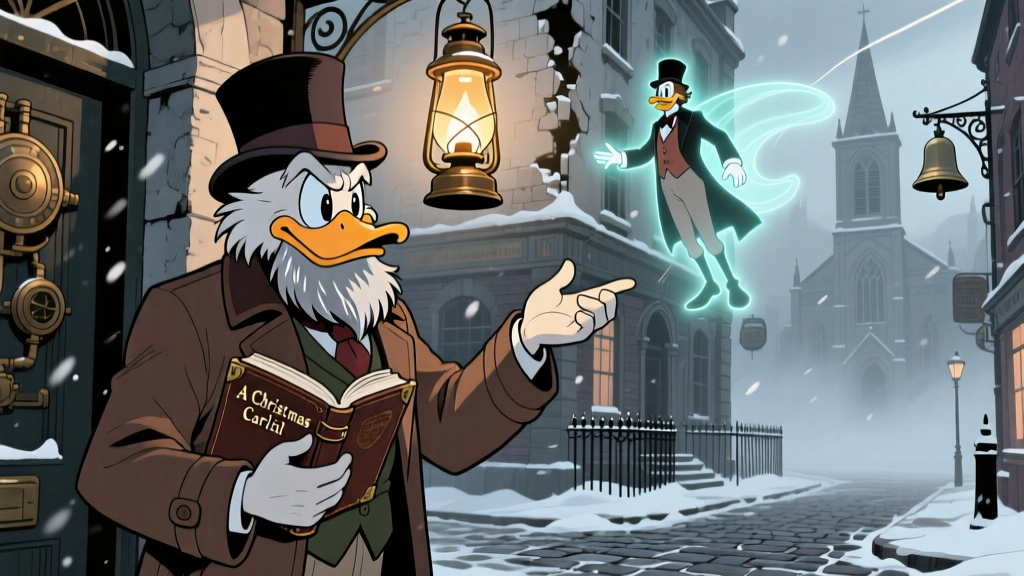
Picture this: it's December 1947, post-war America is buying comics by the millions, and a soft-spoken cartoonist in Hemet, California, needs a villain for a holiday Donald Duck story. Carl Barks pulls a name straight from Charles Dickens—Ebenezer Scrooge—slaps it on a thin, bespectacled duck with mutton-chop whiskers, and sends him to lure his nephews into a booby-trapped cabin on Bear Mountain. Nobody expected the character to survive past the final page. Yet nearly eighty years later, Scrooge McDuck anchors a comics empire, headlined animated series, and an entire mythology that rivals the depth of Middle-earth. And the thread connecting him back to Dickens' 1843 novella is far richer than a borrowed name.
If you've ever wondered how a greedy ghost-story skinflint became one of the most layered protagonists in sequential art, you're in the right place. This guide traces the full arc: from Barks' throwaway antagonist to Don Rosa's twelve-chapter epic, through every Christmas special worth bagging and boarding, and into the collector's market where first editions trade for serious money.
A Name Borrowed from Dickens: The Origin Story
Carl Barks didn't set out to create an icon. In late 1947, Western Publishing needed a 32-page Donald Duck one-shot for the holiday season, and Barks—already the studio's most reliable writer-artist—drew up Christmas on Bear Mountain (Four Color #178, cover-dated December 1947). He needed a wealthy relative who could invite Donald and the nephews to a remote cabin, then terrorize them for laughs. The name "Scrooge" fit a miserly antagonist perfectly; Barks later admitted he simply lifted it from A Christmas Carol, the novella he'd read as a child in Oregon.
That first Scrooge is noticeably thinner and more grotesque than the barrel-chested tycoon fans would later recognize. He walks with a stoop, his beak is sharper, and his personality leans hard into cruelty—he sets traps for his own family. The story sold over 3 million copies, and reader letters flooded Western's offices asking for more of the old duck. Barks obliged in The Old Castle's Secret (Four Color #189, February 1948), then gave Scrooge his own title with Uncle Scrooge #1 in March 1952.
"I just thought of the name. It was a natural for a tight-fisted old guy who had more money than he knew what to do with. Dickens gave me the name, but the rest came from thinking about those Klondike sourdoughs I'd read about as a kid." — Carl Barks, interview with The Comics Journal, 1983
What Barks may not have fully appreciated was how the Dickens association would shape the character's trajectory for decades. Once you name a fictional miser "Scrooge," audiences will inevitably measure him against Ebenezer. That comparison became both a creative engine and a narrative burden—one that every subsequent writer in the franchise has had to reckon with.
The Ebenezer Mirror: Where the Duck Lines Up
Strip away the feathers and the top hat, and the structural parallels between Uncle Scrooge and Ebenezer Scrooge are striking enough to fill a literary seminar. Both characters orbit the same gravitational center: vast wealth accumulated at the expense of human (or, in McDuck's case, duckly) connection.
The miser archetype. Ebenezer Scrooge's counting house and Scrooge McDuck's Money Bin serve identical narrative functions. They're monuments to obsession—physical structures that externalize the character's inner fixation. Ebenezer keeps his coal-box low; McDuck swims in three cubic acres of cash. The scale differs wildly, but the psychology is identical: money as surrogate for intimacy.
Family estrangement. Ebenezer loses Belle, alienates his nephew Fred, and dies alone in the original timeline. McDuck's backstory (codified later by Rosa) includes a decades-long estrangement from his sisters Matilda and Hortense, and his relationship with Donald and Huey, Dewey, and Louie starts from a place of transactional coldness. In Christmas on Bear Mountain, Scrooge tests his nephews with a bear rather than welcoming them warmly—a far cry from family warmth.
The Christmas crucible. For both characters, Christmas is the season when the moral ledger comes due. Ebenezer gets visited by four spirits over a single night. McDuck repeatedly faces his own character-defining tests during the holiday season—Barks set multiple Scrooge stories at Christmas, and the tradition continued through Rosa, Daan Jippes, and modern writers like Don Rosal and Erik Krob.
The capacity for change. This is the big one. Ebenezer's transformation is instantaneous—one harrowing night and he's sending prize turkeys to the Cratchits. McDuck's redemption is slower, messier, and arguably more realistic. Over hundreds of stories, he softens incrementally: he starts caring for his grandnephews, occasionally does good without financial incentive, and even shows vulnerability. But unlike Ebenezer, he never fully sheds his avarice. The tension between generosity and greed is the character's permanent engine, not a problem to be solved in a single night.
Side by Side: Two Scrooges Compared
| Trait | Ebenezer Scrooge (1843) | Scrooge McDuck (1947–) |
|---|---|---|
| Creator | Charles Dickens | Carl Barks (Western Publishing) |
| Wealth source | Moneylending, investments | Gold mining, global enterprise, "squarechasing" |
| Signature prop | Counting house, ledger | Money Bin (#1 dime), top hat, cane |
| Family ties | Nephew Fred; late sister Fan | Donald Duck (nephew), Matilda & Hortense (sisters), Fergus & Downy (parents) |
| Redemption arc | Single-night supernatural transformation | Gradual softening over decades; never fully resolved |
| Christmas role | Central protagonist of the entire story | Recurring holiday setting across multiple stories |
| Moral endpoint | Full conversion to generosity | Permanent tension between greed and love |
Where the Duck Breaks Free
If McDuck were simply Ebenezer with feathers, he'd have faded after a few holiday specials. What makes him endure is everything Barks added that Dickens never touched. The divergences aren't incidental—they're the reason Scrooge McDuck became a protagonist capable of carrying thousands of stories across eight decades.
The Adventurer's Origin
Ebenezer Scrooge inherits nothing and earns his wealth through finance. He's already rich when the story opens, and the narrative never explains how he got there. McDuck, by contrast, has one of the most detailed fictional biographies in all of comics. Barks scattered clues across hundreds of stories—the Klondike Gold Rush, Mississippi riverboating, cattle ranching in Montana, diamond mining in South Africa—and Don Rosa later welded these fragments into a coherent life story.
McDuck's wealth is earned, at least in his telling. He polished boots on the streets of Glasgow at age ten. He shoveled coal on a cattle boat to America. He prospected in the Yukon during the 1896–1899 gold rush. That origin story gives him something Ebenezer lacks: a mythology of merit. Whether readers believe the mythology is another matter—plenty of Scrooge stories show him cutting corners, exploiting loopholes, or outright cheating—but the effort is part of the character's DNA in a way that passive moneylending never could be.
No Spirits Required
Ebenezer needs supernatural intervention to change. Four ghosts descend on his bedroom and literally drag him through past, present, and future. McDuck occasionally encounters ghosts, magic, and mythological beings—Barks loved mixing the mundane with the fantastical—but his character growth comes from relationships, not hauntings. His bond with Huey, Dewey, and Louie is the emotional center of the franchise, and it develops through shared adventure rather than spectral threats. In the best Scrooge stories, the old duck does the right thing not because a ghost told him to, but because he can't quite suppress the part of himself that cares.
Christmas Stories That Define the Character
The holiday season recurs throughout the Scrooge McDuck bibliography with unusual frequency. Barks himself set at least six major stories during Christmas, and the tradition continued under every subsequent creative team. Here are the issues that matter most if you're reading for the Dickens connection.
The Foundational Christmas Stories
- Christmas on Bear Mountain (Four Color #178, December 1947) — Scrooge's first appearance. He invites Donald and the nephews to a cabin in the mountains, ostensibly for a family Christmas, but really to test their courage against a bear. The story is rough around the edges—Scrooge is meaner here than he'd ever be again—but the Christmas setting establishes the holiday as the character's moral proving ground from the very start.
- A Christmas for Shacktown (Uncle Scrooge #37, January 1952) — Often cited as the best Barks Christmas story and one of the top five Scrooge comics ever drawn. Scrooge's money bin develops a crack, and the story weaves together Donald's scheme to earn a Christmas bonus, the nephews' Junior Woodchucks activities, and a spectacular sequence inside the Money Bin. It's the closest Barks came to a Dickensian "heart softens at Christmas" beat, though Scrooge's generosity arrives with comic reluctance.
- The Money Stairs (Uncle Scrooge #32, December 1950) — A shorter tale but important for showing Scrooge's vulnerability. A fire threatens the Money Bin, and the story's emotional register—the old duck genuinely terrified of losing everything—anticipates the deeper character work that later writers would do.
- Uncle Scrooge's Merry Christmas (Uncle Scrooge #354, December 2005) — A later story by Don Rosa's contemporary peers that directly invokes the Dickens template, with Scrooge facing a Christmas-eve moral reckoning played for both laughs and genuine sentiment.
The Direct Dickens Adaptations
Disney has adapted A Christmas Carol with its duck-cast at least three times across different media. The most significant for comics readers is Mickey's Christmas Carol (1983), where Scrooge McDuck plays—naturally—Ebenezer Scrooge, with Donald as Bob Cratchit, Goofy as Jacob Marley, and Mickey as the Ghost of Christmas Past (among other roles). The film was theatrically released and later adapted into comic form multiple times. It remains the most visible point of convergence between the Disney and Dickens versions of the character, and for many readers under forty, it's the first introduction to the idea that these two Scrooges are connected at all.
There's also a 2011 Italian comic adaptation, Topolino #2921–2922, that retells A Christmas Carol with the full Disney duck-cast in a more faithful retelling of the Dickens plot. Written by Tito Faraci and drawn by Giorgio Cavazzano, this version is notable for treating the source material with genuine literary respect rather than just using it as a framework for gags. It was reprinted in English by Fantagraphics in 2018.
Don Rosa and the Scrooge Who Earned His Ghosts
If Carl Barks gave Scrooge McDuck his name and his personality, Don Rosa gave him his soul. Rosa, a Kentucky-born cartoonist and lifelong Barks devotee, began drawing Scrooge stories for Gladstone Publishing in 1987 and quickly became the character's definitive modern voice. His magnum opus, The Life and Times of Scrooge McDuck (12 chapters, published 1992–1994, with supplemental "chapter 0" stories through 2006), is a 200-plus-page biography that traces Scrooge from a shoeshine boy in 1877 Glasgow to the richest duck in the world.
The Dickens connection deepens considerably under Rosa. Where Barks used the name "Scrooge" as a quick character shorthand, Rosa built an entire thematic architecture around the parallels. The Life and Times is structured like a Victorian bildungsroman—each chapter covers a formative period, and the cumulative effect is a character study that earns its emotional weight the way a good novel does.
Rosa's Christmas Masterwork
Rosa's most direct engagement with the Christmas Carol template comes in The Dream of a Lifetime (Uncle Scrooge #329, 2004), a story where Scrooge literally enters the dreamscape of his own past—echoing the Ghost of Christmas Past's journey with Ebenezer. The story revisits key moments from The Life and Times, including the Klondike chapters, and asks whether Scrooge's choices were worth the cost. It's a mature, melancholy piece that treats its character with the seriousness of literary fiction, and it stands as one of the finest Scrooge stories ever written.
Earlier, in The Last Sled to Dawson (Uncle Scrooge #298, 1996), Rosa revisited Scrooge's Klondike past with Goldie O'Gilt, the saloon singer who was the love of his life. The story's central image—an old duck confronting the choices that made him rich and left him alone—is pure Dickens: the ghost of what-could-have-been, rendered in four-color panels.
"Barks created Scrooge as a villain. But the more I studied the stories, the more I saw someone who'd chosen to be alone, not someone who was born cold. That's the Dickens angle—Scrooge McDuck had a Belle too. Her name was Goldie, and he walked away from her for gold." — Don Rosa, Locust Hill Farm newsletter, 2008
Rosa retired from comics in 2006, citing eyesight problems and dissatisfaction with editorial changes. But his body of work—roughly 90 stories, including the full Life and Times—remains the gold standard. Fantagraphics' Don Rosa Library (10 volumes, 2014–2018) collects everything in archival hardcovers and is the single best entry point for readers who want the full Rosa experience.
The Collector's Shelf: Issues Worth Hunting
If you're looking to build a collection around the Uncle Scrooge / Christmas Carol intersection, the market has clear tiers. Prices below reflect approximate 2025–2026 values for mid-grade copies (CGC 6.0–7.5 equivalent) based on recent Heritage Auctions and eBay sold listings.
| Issue | Date | Significance | Mid-grade Value |
|---|---|---|---|
| Four Color #178 | Dec 1947 | First appearance of Scrooge McDuck; Christmas setting | $800–$1,500 |
| Four Color #189 | Feb 1948 | Second appearance; first treasure-hunt story | $300–$600 |
| Uncle Scrooge #1 | Mar 1952 | First issue of the solo series | $500–$1,200 |
| Uncle Scrooge #37 | Jan 1952 | "A Christmas for Shacktown"; peak Barks holiday story | $250–$500 |
| Uncle Scrooge #298 | 1996 | Rosa's "Last Sled to Dawson"; Goldie O'Gilt revisited | $15–$30 |
| Uncle Scrooge #329 | 2004 | Rosa's "Dream of a Lifetime"; Dickens-style memory journey | $10–$25 |
| Don Rosa Library Vol. 1–10 | 2014–18 | Complete Rosa works; Fantagraphics hardcovers | $200–$350 (set) |
The Golden Age Barks issues (Four Color #178 and Uncle Scrooge #1) have climbed steadily for two decades, driven by both Disney collectors and general Golden Age comics investors. A CGC 9.0+ copy of Four Color #178 sold at Heritage for $4,320 in 2023, setting a record for the issue. Modern Rosa issues remain affordable, which makes them an accessible starting point for readers who care more about the stories than speculation.
For readers who want the complete Christmas Scrooge experience without chasing individual issues, Fantagraphics' Carl Barks Library (30 volumes, various editions since 1984) collects every Barks story in chronological order with scholarly annotations. The Christmas stories appear primarily in volumes covering the 1947–1954 period.
Why the Connection Still Matters
Every December, someone rediscovers A Christmas Carol and then discovers—or re-discovers—that a duck in Duckburg has been carrying the Scrooge name forward for almost eighty years. The connection works because it operates on two levels. For casual readers, it's a fun piece of trivia: "Scrooge McDuck is named after the Dickens character!" For deeper readers, it's a genuine case study in how literary archetypes evolve when transplanted into a new medium.
Dickens wrote Ebenezer Scrooge as a warning about industrial-era capitalism—what happens when a person reduces every relationship to a transaction. Barks took that warning and asked a different question: what if the miser also had a life worth living? What if the gold he hoarded came from genuine labor and real risk? And what if, buried under the money, there was still a person who could be reached?
Rosa pushed the question further. His Scrooge isn't just a miser with a heart of gold (cliché as that sounds). He's a man—or a duck—who made deliberate choices, understood their costs, and still can't quite bring himself to choose differently. That's more honest than a one-night ghost visit, and it's what keeps readers coming back. The old duck never fully reforms. He doesn't have to. The tension is the story.
Frequently Asked Questions
Was Scrooge McDuck directly based on Ebenezer Scrooge?
Yes and no. Carl Barks confirmed in multiple interviews that he took the name from Dickens' A Christmas Carol. The initial character—a wealthy, mean-spirited recluse—was clearly modeled on Ebenezer. But Barks developed Scrooge McDuck into a far more adventurous and complex figure than the Dickens original, adding the Klondike backstory, the adventurer persona, and the extended family dynamics that have no parallel in the 1843 novella. By the 1950s, McDuck had become his own character entirely, with only the name and the basic miser archetype linking him back to Dickens.
Which Scrooge McDuck Christmas story should I read first?
Start with A Christmas for Shacktown (Uncle Scrooge #37, January 1952). It's widely regarded as the best Christmas story Barks ever wrote, and it balances humor, action, and genuine warmth in a way that captures everything great about the character. After that, move to Don Rosa's The Dream of a Lifetime (Uncle Scrooge #329) for the more emotionally mature take. Both are available in Fantagraphics' collected editions if you don't want to hunt for singles.
Did Don Rosa consider his Scrooge a version of the Dickens character?
Rosa has addressed this directly in interviews and his personal newsletter. He viewed Barks' Scrooge as a distinct character who shared certain traits with Ebenezer Scrooge—greed, isolation, a complicated relationship with family—but whose life experiences (poverty in Glasgow, adventure in America, the Klondike) made him fundamentally different. Rosa's own contribution was to make those experiences concrete and specific, giving McDuck a biography that stands independent of any Dickens comparison. That said, Rosa deliberately echoed Dickensian themes in stories like The Dream of a Lifetime and The Last Sled to Dawson, treating the parallel as creative fuel rather than a limitation.
Is Four Color #178 expensive to collect?
It depends on condition. A reading-quality copy (torn covers, tape, significant wear) can be found for $100–$200. Mid-grade copies (solid spine, clean interior, minor cover wear) typically sell in the $800–$1,500 range. High-grade (CGC 8.0+) copies are scarce and regularly exceed $3,000 at auction. A CGC 9.2 copy sold for $4,320 at Heritage Auctions in 2023. For most readers, a Fantagraphics reprint edition offers the same story at a fraction of the cost, with superior paper quality and color restoration.
Are there animated adaptations that combine Scrooge McDuck and A Christmas Carol?
The most prominent is Mickey's Christmas Carol (1983), a 26-minute theatrical short where Scrooge McDuck plays Ebenezer Scrooge directly. It was the first theatrical Mickey Mouse cartoon in 30 years and remains a holiday staple. The short was directed by Burny Mattinson and features Clarence Nash's final performance as Donald Duck. Beyond that, DuckTales (both the 1987 and 2017 series) has produced multiple Christmas episodes that borrow Dickensian themes, though none adapt the novella directly. The 2017 DuckTales Christmas special, Last Christmas!, explores Scrooge's past in ways that echo the Ghost of Christmas Past sequences.
What's the complete reading order for Scrooge's major Christmas stories?
Here's a chronological list of the essential holiday issues:
- Christmas on Bear Mountain — Four Color #178 (December 1947)
- The Money Stairs — Uncle Scrooge #32 (December 1950)
- A Christmas for Shacktown — Uncle Scrooge #37 (January 1952)
- Christmas in Duckburg — Uncle Scrooge #92 (December 1960, written by Barks, art by Carl Barks)
- Mickey's Christmas Carol — comic adaptation (1983)
- The Last Sled to Dawson — Uncle Scrooge #298 (1996, Rosa)
- The Dream of a Lifetime — Uncle Scrooge #329 (2004, Rosa)
- Uncle Scrooge's Merry Christmas — Uncle Scrooge #354 (2005)
Read them in order and you'll watch a character evolve from a one-note villain into something Dickens might have recognized: a miser who never quite escapes his own nature, but who keeps trying anyway. That's not a bad legacy for a duck named after a ghost story.
Sources referenced: Carl Barks interview, The Comics Journal #85 (1983); Don Rosa, Locust Hill Farm newsletter (2008); Heritage Auctions sold lot records, Comics & Comic Art Signature Auctions (2022–2025); Fantagraphics Carl Barks Library editorial notes; The Don Rosa Library Vol. 1–10, Fantagraphics (2014–2018).