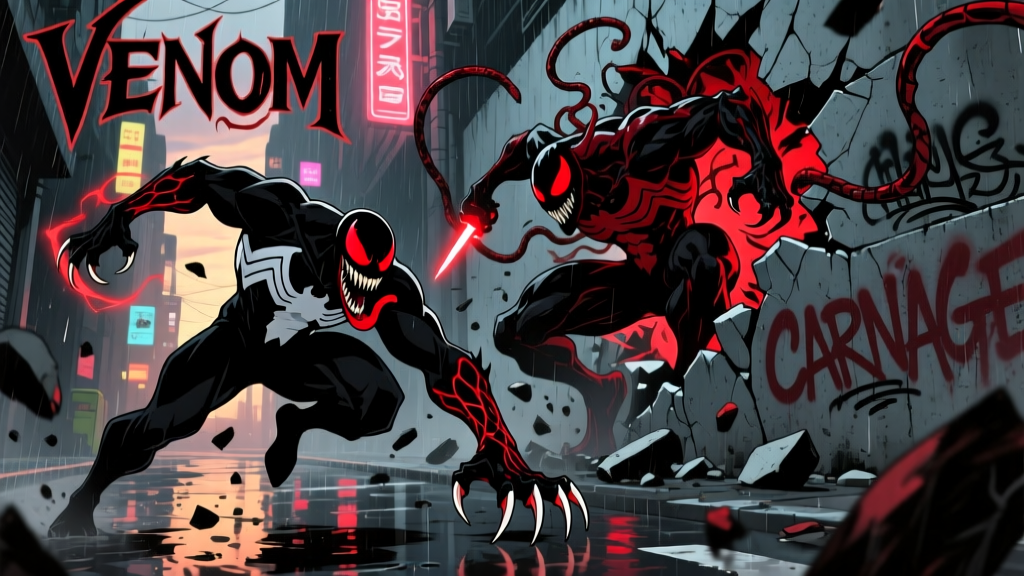
A black alien sludge bonds with a disgraced journalist in a prison cell. Months later, a piece of that same sludge slithers into the ear of a serial killer sharing that cell. One symbiote wants to be a father. The other wants to paint the walls red. That is the origin of the venom vs carnage rivalry — not a clash between strangers, but a family war between parent and child, and it has been burning through Marvel Comics for over thirty years without losing a single ounce of its brutality.
The Venom-Carnage conflict has produced some of the best-selling crossover events of the 1990s, redefined what a Spider-Man villain could be, and spawned two blockbuster films, a half-dozen video game appearances, and enough merchandise to fill a Hot Topic from floor to ceiling. But strip away the marketing and you are left with something surprisingly intimate: a story about a broken parent trying to destroy the monster it accidentally created. That emotional core is why this rivalry has outlasted nearly every other superhero feud Marvel has ever printed.
The Symbiote Family Tree: How Venom Birthed Carnage
To understand the venom vs carnage dynamic, you have to start with the alien symbiote itself. The Klyntar — that's the species name, established decades after the black suit first showed up in Amazing Spider-Man #252 (May 1984) — is a race of parasitic organisms that bond with host bodies to survive. The Venom symbiote was considered defective by its own kind because it preferred permanent bonding over cycling through hosts. That defect is the reason every symbiote conflict in Marvel exists: a broken alien fell in love with the wrong species and couldn't let go.
Eddie Brock became Venom in Amazing Spider-Man #300 (May 1988), written by David Michelinie with art by Todd McFarlane. McFarlane's design — the hulking frame, the drooling jaw full of fangs, the white spider emblem stretched across a black mass — was a deliberate escalation from Spider-Man's own black suit. Venom was bigger, meaner, and looked like what would happen if Spider-Man's costume grew teeth and a temper. The character was an immediate sales hit. ASM #300 is now one of the most valuable Bronze Age keys in the hobby, with CGC 9.8 copies trading above $30,000.
But the real escalation came three years later. In Amazing Spider-Man #344 (March 1991), Eddie Brock was imprisoned at Ravencroft Institute. The Venom symbiote broke in to rescue him. During the escape, the symbiote asexually reproduced — it left behind an offspring, a small fragment of itself that bonded with Brock's cellmate: Cletus Kasady, a convicted mass murderer with no moral compass, no code of honor, and absolutely no interest in being anyone's anti-hero.
The Parent-Child DynamicHere is what makes this different from every other superhero rivalry: Venom is Carnage's biological parent. Not metaphorically. The Carnage symbiote is a direct genetic offspring of the Venom symbiote, and the two organisms recognize each other on a chemical level. Venom feels a compulsion to protect — and later destroy — its child. Carnage feels nothing but contempt for the parent it considers weak. This isn't hero vs. villain. It is the most dysfunctional family in Marvel, wrapped in alien flesh and fighting to the death over it.
Kasady named himself Carnage. The symbiote bonded with his blood — literally, the organism fused at a cellular level that went deeper than any previous Klyntar bond — and the result was something far more dangerous than Venom. Where Eddie Brock had rage tempered by a twisted sense of justice, Cletus Kasady had only appetite. He wanted to kill, and the symbiote amplified that desire into a weapon of mass destruction.
Maximum Carnage (1993): The Event That Defined the Rivalry
If you ask any comic shop employee from the 1990s to name the event that sold the most copies in their store that year, there is a strong chance they will say Maximum Carnage. Published across fourteen issues spanning five Spider-Man titles in mid-1993, Maximum Carnage was Marvel's first major symbiote crossover — and it was a commercial juggernaut that moved over one million copies across its tie-in issues (according to Diamond Comic Distributors' 1993 year-end reports).
The premise was simple and terrifying: Carnage escaped Ravencroft, assembled a team of supervillains — Shriek, Demogoblin, Carrion, and the Doppelganger — and went on a killing spree across New York City. Spider-Man couldn't stop him alone. He couldn't even stop him with the Avengers, who showed up but were written out quickly because the writers wanted this to feel like a street-level war, not a cosmic one. The only entity with a real chance at stopping Carnage was the one who created him: Venom.
Eddie Brock's role in Maximum Carnage is where the parent-child dynamic crystallized. Venom didn't want to kill Carnage out of heroism. He wanted to kill Carnage because he considered the offspring his responsibility — a mistake he had made that only he could clean up. The narrative framed it as a father hunting a rabid child, and that emotional framework elevated what could have been a standard superhero slugfest into something with genuine weight. When Venom finally confronted Carnage in Web of Spider-Man #103, the fight was brutal, personal, and shot through with an almost tragic intensity.
"Maximum Carnage wasn't subtle. It was loud, it was bloody, and it was unapologetically commercial. But it worked because it understood something most crossover events forget: the best fights are the ones where the combatants actually know each other." — Sean Howe, Marvel Comics: The Untold Story (2012)
The event also gave us one of the most iconic comic book images of the decade: the cover of Spider-Man Unlimited #1 (July 1993), drawn by Tom Lyle, showing Venom and Carnage locked in a symbiote-vs-symbiote grapple while Spider-Man dangles between them. That single image — black against red, parent against child — became the definitive visual shorthand for the entire rivalry. It has been reprinted, homaged, and parodied more times than Marvel's marketing department can count.
Maximum Carnage ended with Carnage defeated but not destroyed. The symbiote separated from Kasady and was taken into custody by the Avengers. Kasady survived, which meant the door was always open for a rematch. Marvel, predictably, walked through that door many times over the following decades.
Power Comparison: Venom vs Carnage
The strength hierarchy in the symbiote family is counterintuitive. You might assume the parent is stronger than the child. In the Venom-Carnage dynamic, the opposite is true — at least in raw power. Carnage is the more physically powerful symbiote, and the reasons for that are baked into the biology of how Klyntar reproduction works.
Each generation of symbiote offspring is stronger than its parent. This is a canon rule established in the comics and reinforced across multiple storylines. The Carnage symbiote, as a first-generation offspring of Venom, is inherently more powerful in terms of raw strength, speed, and the versatility of its shape-shifting abilities. It can form weapons out of its biomass — axes, blades, projectile spikes — with a speed and precision that Venom cannot match. Venom relies on brute force, tendrils, and the classic web-like constructs inherited from its time bonded with Spider-Man. Carnage turns its entire body into an arsenal.
But raw power is only half the equation. Venom has two advantages that Carnage lacks: experience and a functioning brain. Eddie Brock, for all his instability, is a tactical thinker. He plans. He adapts. He uses his environment. Cletus Kasady does none of those things. He charges in screaming, and the Carnage symbiote amplifies that recklessness rather than tempering it. Venom wins fights against Carnage not by overpowering him but by outthinking him — and by exploiting the one weakness that all symbiotes share: vulnerability to fire and sonic frequencies.
| Attribute | Venom (Eddie Brock) | Carnage (Cletus Kasady) |
|---|---|---|
| Raw Strength | Class 50+ (can lift ~50 tons) | Class 80+ (stronger than parent by generational rule) |
| Speed | Superhuman; faster than Spider-Man in short bursts | Faster; more agile; better acceleration |
| Shape-shifting | Tendrils, shields, basic weapon forms | Full-body weapon generation; axes, blades, spikes, projectile attacks |
| Stealth | Invisible to Spider-Sense; can mimic clothing | Same Spider-Sense immunity; can mimic other humans' appearances |
| Healing Factor | Advanced; can heal host injuries and cure certain diseases | More advanced; faster regeneration from catastrophic damage |
| Bond Strength | Strong but separable under extreme conditions | Blood-level bond; near-impossible to separate without killing host |
| Weakness: Fire | Severe vulnerability | Severe vulnerability (slightly more resistant than Venom) |
| Weakness: Sonics | Severe vulnerability | Severe vulnerability |
| Host Intelligence | Eddie Brock: tactical, calculating, capable of restraint | Cletus Kasady: chaotic, impulsive, no restraint whatsoever |
| Combat Style | Brawler with strategy; uses environment and planning | Berserker; overwhelms with speed, volume of attacks, and unpredictability |
| Stats compiled from primary comic appearances across Amazing Spider-Man, Venom solo series, and Carnage miniseries (1991–2025). Strength classifications use Marvel's official handbook tiers where available. | ||
The generational strength gap matters in every direct confrontation. When Venom and Carnage fight — and they have fought many times — Venom is always at a physical disadvantage. The drama in these fights comes from watching the weaker parent find ways to neutralize the stronger child. Sometimes Venom recruits allies (Spider-Man, most often). Sometimes he uses fire or sonic weapons. Sometimes he simply endures more punishment than Carnage expects, banking on the fact that Kasady's arrogance will eventually create an opening.
Each generation of symbiote is stronger than the one before it. That biological rule is the reason Venom has never beaten Carnage in a straight fistfight — and never will.Key Battles Across Three Decades
The venom vs carnage conflict didn't end with Maximum Carnage. It evolved. Each new encounter added layers to the relationship, escalated the violence, and pushed both characters into territory that neither occupied when they started.
Carnage U.S.A. (2011–2012)
Conway's five-issue miniseries Carnage U.S.A. brought Cletus Kasady back after a period where the symbiote had been separated from him. The story sent Carnage on a cross-country killing spree through small-town America, and it was genuinely disturbing in a way that Maximum Carnage never quite managed. Conway wrote Kasady as a force of nature — less a person than a contagion — and the series leaned into horror rather than superhero convention. Venom showed up for the final confrontation, but the real tension was watching ordinary communities deal with a threat that no amount of local law enforcement could handle.
Dead No More: The Clone Conspiracy and Beyond
The mid-2010s saw Marvel experiment with symbiote lore in ways that expanded the mythology considerably. Dead No More: The Clone Conspiracy (2016) tied Carnage into Spider-Man's clone saga, and while the crossover was uneven, it produced some memorable Venom-Carnage moments. The follow-up, Venomized (2018), saw the symbiote bond with multiple Marvel heroes and villains during a crisis, including a sequence where the Carnage symbiote briefly bonded with — and was amplified by — a cosmic entity. The power scaling got absurd, but it demonstrated that Marvel saw Carnage as a threat-level that could credibly endanger the entire Marvel Universe, not just one street in Manhattan.
Absolute Carnage (2019)
If Maximum Carnage was the 1990s defining event, Absolute Carnage was its modern successor. Written by Donny Cates with art by Ryan Stegman, this five-issue miniseries (with numerous tie-ins) introduced Knull, the primordial deity of the symbiote species — a god of darkness who created the Klyntar as weapons and had been imprisoned at the center of their homeworld for millennia. Cates recontextualized the entire symbiote mythology: Venom, Carnage, and every other symbiote were fragments of a cosmic entity that predated the universe itself.
In Absolute Carnage, the Carnage symbiote bonded with Knull's power and became something apocalyptic. Kasady gained the ability to create symbiote dragons, to control other bonded organisms, and to threaten the entire planet. Venom, Spider-Man, and a coalition of symbiote hosts had to stop him. The event was massive in scope, but Cates kept the emotional focus tight: this was still a parent trying to destroy what it had made. Eddie Brock's desperation in these issues — his willingness to sacrifice himself, his host body, and his identity to stop his offspring — was the strongest writing the character had received since his debut.
King in Black (2020–2021)
King in Black was the culmination of Cates' entire symbiote saga. Knull invaded Earth with an army of symbiote dragons, and the only way to stop him was for Eddie Brock to fully embrace his role as the symbiote's true partner — not its slave, not its host, but its equal. The Venom-Carnage dynamic took a backseat to the cosmic war, but Kasady appeared in tie-in issues and the event reinforced a critical piece of lore: Carnage had been trying to free Knull all along. The child wasn't just a killer. It was a zealot, devoted to a god of destruction that even the other symbiotes feared.
The Venom vs Carnage Rivalry in Film
The rivalry jumped from page to screen in Venom: Let There Be Carnage (2021), directed by Andy Serkis. Tom Hardy reprised his role as Eddie Brock/Venom, and Woody Harrelson played Cletus Kasady — a casting choice that divided fans before release but ultimately produced one of the more memorable villain performances in the Sony Spider-Man Universe.
The film followed the comic blueprint closely in terms of the symbiote family dynamic. Eddie and the Venom symbiote were living in uneasy domesticity when Kasady, on death row, bit Eddie's hand during a prison interview. The Venom symbiote's blood entered Kasady's system, and the Carnage organism grew from it — identical to the comics' asexual reproduction concept, translated into the slightly different language of film biology.
The third act was pure symbiote-vs-symbiote spectacle. Venom and Carnage fought in a church, on city streets, and across rooftops in sequences that leaned into the body-horror potential of shape-shifting alien organisms. The film grossed $506 million worldwide against a $110 million budget (Box Office Mojo), proving that the venom vs carnage keyword had commercial legs well beyond the comic shop. Critics were mixed — the film holds a 57% Rotten Tomatoes score — but audiences showed up, and the post-credits scenes tied the Venom franchise into the broader Spider-Man multiverse that Sony and Marvel were building.
Hardy's Venom played the reluctant parent with genuine pathos. The scene where Venom refers to Carnage as "a red one" — with the tone of a parent describing a problem child to a stranger — captured the entire rivalry in three words. It was funny, it was dismissive, and underneath it was the exhaustion of a creature that knew it had created something it couldn't control.
Other Screen Appearances
Before the live-action films, the Venom-Carnage rivalry appeared in animated form across several projects. The Spider-Man: The Animated Series (1994–1998) introduced both symbiotes to a generation of Saturday-morning viewers, and the two-part Carnage arc in Season 3 was one of the show's darker storylines — as dark as Fox Kids Standards & Practices would allow, which wasn't very. The more recent Spider-Man animated series (2017–2020) on Disney XD gave both characters updated designs and more faithful adaptations of the Maximum Carnage storyline.
Venom vs Carnage in Video Games
The symbiote rivalry has been a recurring feature of Marvel video games for over two decades, and each adaptation has found different ways to translate the comic-book violence into interactive form.
- Spider-Man and Venom: Maximum Carnage (1994, SNES/Genesis) — The first video game to feature the rivalry. A side-scrolling beat-em-up that adapted the 1993 crossover. Players could switch between Spider-Man and Venom, with each character having distinct combat moves. The game was punishingly difficult and remains a cult favorite among retro collectors. A sealed SNES copy sold for $10,000+ at Heritage Auctions in 2023.
- Spider-Man 2: Enter Electro (2001, PS1) — Featured a bonus Carnage boss fight that was unlocked after completing the main game. The fight was brief but memorable for its visual design — a red-and-black blur tearing through a warehouse while the player tried to dodge weaponized tendrils.
- Ultimate Spider-Man (2005, multi-platform) — Adapted the Ultimate universe versions of both symbiotes. Carnage was created from a combination of the Venom symbiote and Peter Parker's DNA, adding a genetic layer to the parent-child concept. The boss fight required the player to use environmental hazards (fire, electricity) rather than direct attacks, reflecting the comics' power-differential problem.
- Spider-Man: Web of Shadows (2008, multi-platform) — While Carnage was not a primary villain, the symbiote mechanics allowed players to experience the shape-shifting combat that defines these characters. The game's symbiote system — where you could switch between Spider-Man's red suit and the black suit mid-combo — showed what interactive symbiote fights could feel like.
- Marvel: Future Fight (2015, mobile) and Marvel Contest of Champions (2014, mobile) — Both games feature Venom and Carnage as playable characters with distinct move sets. The rivalry is referenced through team-up bonuses and story dialogue. Contest of Champions has run multiple symbiote-themed events that recreate key comic confrontations.
- Marvel's Spider-Man 2 (2023, PS5) — Insomniac's sequel brought both Venom and a symbiote-adjacent threat to the PlayStation 5. While Carnage specifically did not appear as a named character, the symbiote storyline in the game drew heavily from the Venom-Carnage mythos, and the game's post-credits content strongly hinted at Carnage's future inclusion in the franchise.
Why This Rivalry Won't Die
Marvel has tried to retire both characters. Venom got a heroic sacrifice in 2018's Venom #165 (he came back, obviously). Carnage has been "killed" at least four times across different storylines. Neither death sticks, because the symbiote concept itself is too useful to Marvel's publishing strategy: an alien organism that can bond with any character, creating infinite variation on a proven formula.
But the Venom-Carnage rivalry specifically endures because it is built on something more durable than a typical hero-villain dynamic. It is a family story. The parent who created something terrible. The child who surpassed the parent in power but lacked the parent's capacity for growth. The father who cannot stop fighting the son because the son will not stop killing. These are old narratives — they predate comic books by thousands of years — and they work just as well wrapped in alien biomass as they do in Greek tragedy or Shakespeare.
Donny Cates understood this when he wrote Absolute Carnage and King in Black. He treated the symbiote family tree as mythology — Knull as the dark god, Venom as the rebellious creation, Carnage as the fanatic who serves the old god rather than evolving beyond it. That mythological framework gave the rivalry new depth without abandoning the street-level violence that made it popular in the first place.
The venom vs carnage conflict also benefits from something rare in superhero comics: clear escalation. Each major confrontation has been bigger than the last. Maximum Carnage was a city-wide killing spree. Carnage U.S.A. went national. Absolute Carnage went global. King in Black went cosmic. The next chapter — whatever Marvel has planned for the post-Cates era — will presumably go further. That trajectory keeps readers invested because there is always a larger threat on the horizon, and the parent-child dynamic at the center of it all hasn't been resolved. It probably never will be. And that's the point.
Frequently Asked Questions
Who is stronger, Venom or Carnage?
Carnage is stronger in raw physical power. Marvel's symbiote biology establishes that each generation of offspring is more powerful than its parent. Since Carnage is a first-generation offspring of the Venom symbiote, it is inherently stronger, faster, and more versatile in its shape-shifting abilities. However, Venom compensates through tactical intelligence and host discipline — Eddie Brock is a smarter fighter than Cletus Kasady, and that gap has decided more than one confrontation.
How was Carnage created from Venom?
In Amazing Spider-Man #344 (March 1991), the Venom symbiote broke into Ravencroft Institute to rescue its host, Eddie Brock. During the escape, the symbiote asexually reproduced, leaving behind an offspring that bonded with Brock's cellmate, Cletus Kasady. The new symbiote bonded with Kasady at a deeper level — fusing with his blood — which gave it greater power but also made it nearly impossible to separate from its host without killing him.
What is Maximum Carnage and why does it matter?
Maximum Carnage was a fourteen-issue crossover event published across five Spider-Man titles in 1993. It was the first major storyline to pit Venom directly against Carnage in a sustained conflict, and it established the parent-child emotional framework that every subsequent symbiote story has built on. The event sold over one million copies and remains one of the best-selling Spider-Man crossovers of the 1990s. It was adapted into a SNES/Genesis video game in 1994.
Has Carnage ever been permanently killed?
No. Carnage has been "killed" multiple times — separated from the symbiote, the symbiote seemingly destroyed, Kasady executed or apparently dead — but the character always returns. The symbiote's ability to regenerate from microscopic fragments means that as long as Marvel wants to publish Carnage stories, there is a plausible in-universe explanation for his return. The most recent major "death" occurred during Absolute Carnage (2019), but Kasady resurfaced in subsequent storylines.
Is Venom: Let There Be Carnage faithful to the comics?
The 2021 film follows the comic blueprint for the symbiote family dynamic — Venom's offspring bonding with a serial killer host and becoming more powerful than its parent. The prison origin, the blood-bond concept, and the climactic symbiote-vs-symbiote fight all have direct comic counterparts. Where the film diverges is in tone: the movie is significantly more comedic than the source material, and it introduces the character of Shriek (played by Naomie Harris) with a different origin and power set than her comic version. The overall narrative arc, however, is recognizable to anyone who has read Maximum Carnage.
Who is Knull and how does he connect to the Venom-Carnage rivalry?
Knull is the primordial god of the symbiotes, created by writer Donny Cates during his Venom run (2018–2021). He is an ancient cosmic entity who created the Klyntar as weapons of conquest before being imprisoned by his own creations. In Absolute Carnage (2019), the Carnage symbiote bonds with Knull's power and becomes apocalyptically dangerous. In King in Black (2020–2021), Knull invades Earth. The Carnage-Venom rivalry is reframed through this mythology: Venom rebels against its creator-god, while Carnage serves Knull as a zealot. This adds a religious dimension to the family conflict.
What is the best comic to start reading the Venom-Carnage rivalry?
Maximum Carnage (collected in trade paperback) is the foundational text and reads well even thirty years later. For a modern entry point, Donny Cates' Venom run starting with Venom #1 (2018) builds toward both Absolute Carnage and King in Black while being accessible to readers with no prior symbiote knowledge. Cates' run is widely considered the best Venom writing since the character's debut and is available in collected editions. If you want the full chronological experience: Amazing Spider-Man #300 (Venom's debut), ASM #344 (Carnage's origin), Maximum Carnage, then Cates' run through King in Black.
Thirty years and counting. The black symbiote and the red one are still fighting in the pages of Marvel Comics, still showing up in films and games, still selling t-shirts and Funko Pops and oversized hardcovers. The reason isn't complicated. Marvel accidentally wrote one of the most human stories in its catalog and wrapped it in alien goo. A parent cannot stop trying to destroy what it made. A child cannot stop trying to prove it is more than what made it. Neither one wins. Neither one stops. And readers keep showing up to watch them try.