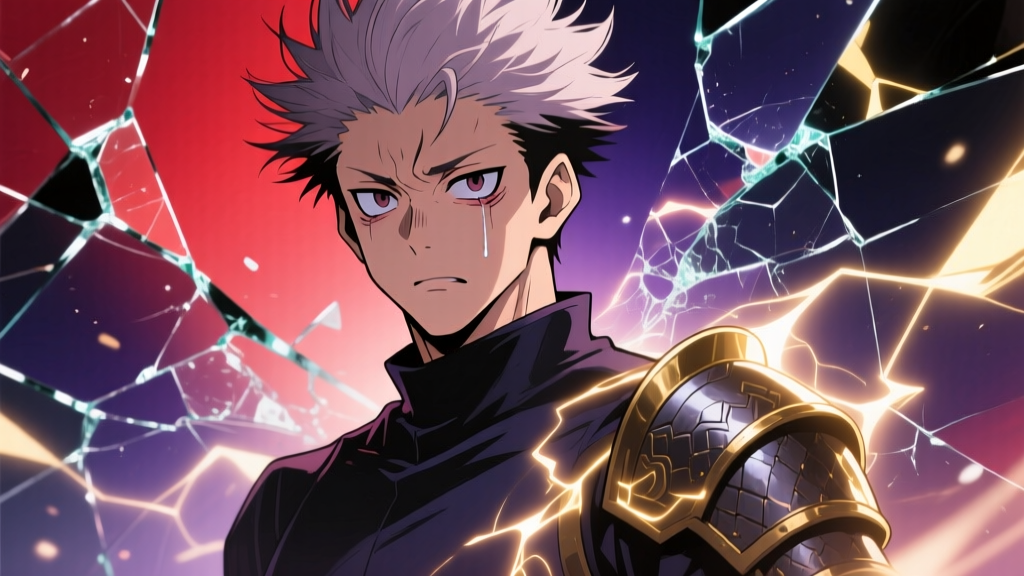
Gojo Satoru isn’t untouchable—he’s unmoored.
That’s the first thing I noticed rewatching Episode 23 of Jujutsu Kaisen Season 2—the Shibuya Incident arc’s quiet, devastating prelude. Gojo stands alone on a rooftop, wind lifting his blindfold just enough to reveal one eye—calm, tired, almost bored—not because he’s indifferent, but because he’s been waiting for someone to *see* him for twenty years and no one ever did. Not really. Not past the spectacle. Not past the “Strongest Sorcerer” label stamped like a seal on his forehead.
His power isn’t just overwhelming—it’s ontologically disruptive. Limitless isn’t a combat technique; it’s a condition of existence. It bends causality (Cursed Technique Reversal: Red), erases perception (Blue), and dissolves space itself (Hollow Purple). But here’s what the anime doesn’t say outright, and what Gege Akutami buries in quiet glances and offhand jokes: Gojo’s abilities don’t just make him stronger than everyone else—they make him structurally incompatible with human connection.
I remember watching him teach Yuji in Episode 4 of Season 1, leaning against the chalkboard with his hands in his pockets, explaining domain expansion like he’s describing how to boil an egg. He doesn’t lecture. He *invites*. When Yuji panics mid-training, Gojo doesn’t correct him—he pauses, tilts his head, and says, “You’re scared of failing. Good. That means you care.” That’s not pedagogy. That’s diagnosis. He reads emotional subtext like ambient noise. He knows exactly where Yuji’s fear lives—in the gap between wanting to protect people and believing he’s too weak to do it. So Gojo doesn’t train Yuji’s cursed energy. He trains his self-worth.
That’s his teaching philosophy in three words: Meet them where they are. Not where they should be. Not where the Jujutsu High curriculum says they ought to be. Where they *are*: emotionally raw, existentially shaky, socially stunted. Look at Nobara. He never praises her hammer technique. Instead, he notices she flinches when others touch her belongings—and later, he lets her keep her nails long, even though they’re technically a liability. He doesn’t fix her “flaws.” He affirms her boundaries as legitimate. With Megumi, he doesn’t push him to “accept his heritage.” He waits—through two seasons—until Megumi chooses to ask about his father. Then Gojo answers, flat and precise: “He loved you. He also chose power over you. Those things can coexist.” No moralizing. No evasion. Just duality held without collapse.
This works because Gojo understands hierarchy not as domination, but as responsibility—and responsibility requires proximity. Yet he’s the one person in the entire jujutsu world who cannot afford proximity. His presence warps reality. His gaze literally stops time for others. His very aura repels low-level curses—not out of intent, but physics. Even in casual conversation, he instinctively dampens his output, like a nuclear reactor running at 3% capacity so the room doesn’t melt. That’s exhausting. And lonely.
The irony isn’t that the strongest dies. It’s that he dies *because* he’s the strongest—and because he refuses to let that strength poison his humanity. Sukuna calls him “a man who clings to morality like a child clinging to a toy.” That’s not mockery. It’s recognition of something alien: Gojo treats ethics as non-negotiable infrastructure, not optional decoration. He breaks rules constantly—but only to uphold deeper ones. He smuggles Yuji into Jujutsu High despite the death penalty. He spares Mahito—not out of weakness, but because he believes redemption is possible, even for a curse born from human despair. He tells Geto, in their final confrontation in Episode 13, “You think you’re saving people by killing them? That’s not salvation. That’s just another kind of violence.” He doesn’t shout it. He says it like he’s disappointed in a student who copied homework.
And that’s the real burden: Gojo carries the weight of being the only adult in the room who still believes in growth. Everyone else has calcified—Uraume in nihilism, Kenjaku in cosmic cynicism, even Principal Yaga in bureaucratic resignation. Gojo hasn’t. He watches Yuji struggle with grief and says, “Grief isn’t a sign you’re broken. It’s proof you were whole enough to love.” He says this while standing in front of a sealed prison where his best friend is rotting—not as a contradiction, but as continuity. His compassion isn’t diluted by trauma. It’s forged in it.
Which makes his death in Shibuya not a failure of power—but a triumph of principle. He lets himself be sealed not because he’s outsmarted, but because he refuses to fight in a way that would vaporize the city block where Yuji and Nobara are hiding. He calculates the exact vector, the precise timing, the minimal collateral—and then walks into the trap. His last act isn’t a blast of Hollow Purple. It’s a whispered “I’ll leave the rest to you,” directed at Yuji, eyes closed, smile faint, blindfold already slipping. He doesn’t die fighting. He dies *trusting*.
That trust is the sharpest edge of his tragedy. Because the people he trusts—Yuji, Megumi, even Maki—are still learning how to hold it. In Episode 1 of Season 3, Yuji stares at Gojo’s empty chair in class and doesn’t speak for twelve seconds. The silence isn’t dramatic. It’s hollow. That chair isn’t just furniture. It’s gravitational absence. Without Gojo’s presence as a reference point—his humor as pressure valve, his judgment as compass, his sheer *scale* as reassurance—the world tilts. Characters don’t just mourn him. They misread situations, overcorrect, freeze. Megumi nearly kills himself trying to replicate Gojo’s style. Yuji abandons his own instincts to mimic Gojo’s confidence—until he realizes, in Episode 8, that Gojo never wanted him to be a copy. He wanted him to be *Yuji*.
Here’s what most analyses miss: Gojo’s isolation isn’t passive. It’s curated. He wears the blindfold not just to restrain his power—but to create a threshold. When he removes it, it’s never for show. It’s for precision. For intimacy. For consequence. He takes it off to fight Suguru Geto—not to win, but to *witness* his friend’s final choice. He takes it off to look at Yuji after the Shibuya Incident—not to assess damage, but to say, without words: I see you. All of you. Even the part that’s terrified.
His fashion—those sunglasses, that coat, the white hair—isn’t just aesthetic. It’s semiotic armor. It signals “I am approachable, but not accessible. I am present, but not contained.” He hosts parties at his apartment, plays video games with students, cracks lewd jokes—but he never invites anyone into his past. We learn about his childhood only through fragments: a photo of him and Geto as kids, Gojo’s offhand comment to Nanami (“I was never allowed to lose”), and that single, chilling line to Kenjaku: “You made me watch my best friend turn into a monster. You think I don’t know what it costs to choose?”
That cost is the core. Gojo’s strength didn’t spare him pain—it multiplied its resonance. Every life he saves echoes with the ones he couldn’t. Every student he mentors carries the shadow of the one he failed: Suguru Geto. His entire pedagogy is built on preventing that recurrence—not through control, but through radical empathy. He doesn’t want Yuji to avoid Geto’s path by being stronger. He wants him to avoid it by being *kinder to himself*.
So no—Gojo Satoru isn’t the Strongest Sorcerer because he wins every fight. He’s the strongest because he endures the unbearable lightness of absolute power without letting it evaporate his conscience. He’s the strongest because he teaches kids how to cry in front of each other and call it training. He’s the strongest because he dies knowing Yuji will fail, will rage, will doubt—and will still, somehow, choose to protect.
That’s not invincibility. That’s devotion.
And devotion, unlike cursed energy, doesn’t scale. It only deepens—with every risk taken, every boundary honored, every blindfold lifted just enough to let someone feel seen.