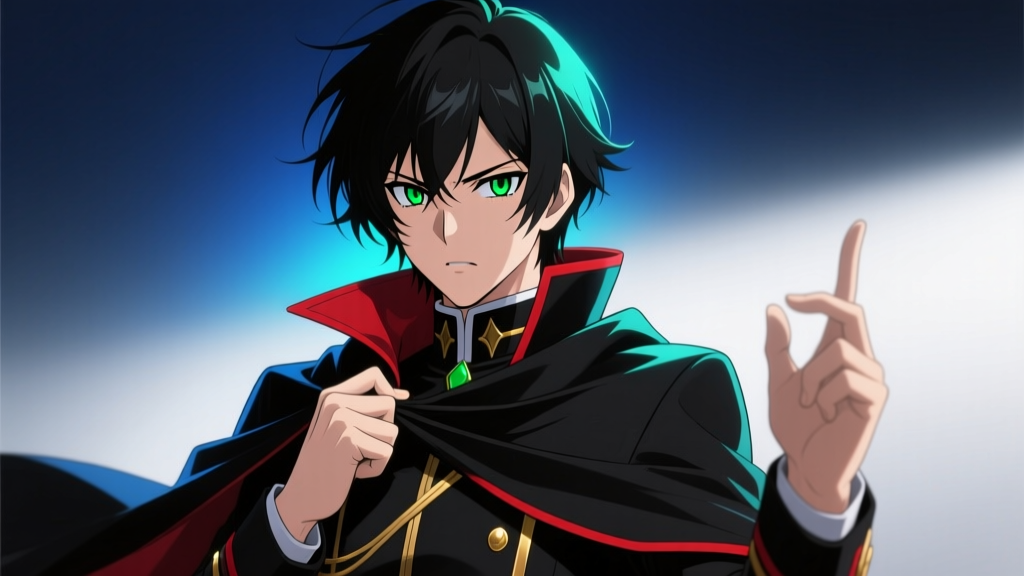
Lelouch vi Britannia: The Anti-Hero Who Broke the Mold
He didn’t save the world—he murdered it into silence, then bowed politely as it bled out.
Lelouch Lamperouge isn’t just an anti-hero. He’s the anti-hero who walked into the genre’s living room, poured himself tea, and then calmly dismantled every moral assumption the audience brought with them. Code Geass: Lelouch of the Rebellion doesn’t ask whether Lelouch is “good” or “evil.” It forces you to watch him manipulate, betray, gaslight, and sacrifice—often in the same episode—and then ask why you still lean forward when he speaks.
Let’s cut through the fan-service reverence first: Lelouch is not a tragic hero. He’s not a misunderstood genius wronged by fate. He’s a prodigy of cruelty who weaponized empathy like a scalpel—precise, cold, and always aware of where the nerves lie. His moral complexity isn’t philosophical window-dressing. It’s structural. It’s baked into the show’s DNA, from the opening shot of his bloodstained chessboard to the final frame of his own corpse draped over a throne he never wanted to sit on.
The Theater of Control
Lelouch doesn’t scheme—he directs. Every major arc in Code Geass plays out like a stage production where he’s playwright, director, lead actor, and stage manager—all while wearing a mask that hides nothing but his eyes.
Take Episode 12 (“The White Knight Returns”). Suzaku’s public execution is staged not for tactical necessity, but for emotional choreography: Lelouch knows the crowd needs a martyr to rally against, and Suzaku—willingly, heartbreakingly—becomes the prop. He doesn’t just fake Suzaku’s death; he fakes the *meaning* of it. The crowd weeps for justice. Lelouch watches from the rafters, calculating how many more tears will make them compliant.
Or consider the Kyoto House massacre (Episode 22, “The Stolen Mask”). Lelouch orders Jeremiah to execute civilians—not because they’re threats, but because their deaths will fracture the Black Knights’ unity and force Kallen to choose between loyalty and conscience. He doesn’t flinch. He doesn’t monologue about burden. He gives the order, adjusts his collar, and walks away. That’s not Shakespearean tragedy. That’s Brechtian alienation—designed to make you uncomfortable, not cathartic.
This theatricality isn’t vanity. It’s strategy forged in trauma: a prince raised in exile, watching his mother die while his father watched impassively, learning early that power isn’t seized—it’s performed. Zero isn’t a disguise. It’s the only identity Lelouch trusts enough to be honest inside. Behind the mask, he lies constantly—to Nunnally, to C.C., even to himself. But as Zero? He tells brutal truths. “I am the one who will destroy the world,” he says in Episode 25, not as confession, but as mission statement.
Moral Complexity Without Excuse
Many anti-heroes get moral passes because they’re “driven by loss” or “fighting a greater evil.” Lelouch gets no such pass—because he refuses it.
Yes, he lost his mother. Yes, he was used as a political pawn. But the show makes it brutally clear: those wounds explain him, but they don’t justify him. In Episode 17 (“The Holy War”), he manipulates Rolo into killing a diplomat—not out of necessity, but because Rolo’s unstable devotion is *more useful* than his stability. Lelouch knows Rolo is broken. He uses that breakage like a key. Later, when Rolo realizes he’s been played, Lelouch doesn’t comfort him. He stares at him, expressionless, and says, “You were convenient.”
That line—“You were convenient”—is the thesis of Lelouch’s morality. Not “I had no choice.” Not “It was for Nunnally.” Just: *convenient*. He treats people as instruments, and the show never softens that. Even his love for Nunnally—the one thing fans cite as his “pure” motive—is interrogated relentlessly. In Episode 20 (“The Day a New Demon Was Born”), he lies to her about his identity while holding her hand, his voice gentle, his eyes already calculating how far he’ll go before she finds out. His love is real—but it’s also the most dangerous lever he has.
C.C. sees this. She calls him out repeatedly—not with anger, but with weary amusement. “You think your suffering makes you special?” she asks in Episode 14. “Everyone suffers. You just chose to make yours useful.” That’s the show’s quiet indictment: Lelouch’s brilliance doesn’t absolve him. It amplifies his culpability.
Zero Requiem: Triumph, Failure, or Both?
The Zero Requiem—the plan where Lelouch frames himself as a tyrant, lets Suzaku kill him publicly, and uses his death to unify the world under peace—isn’t the climax of his arc. It’s the punchline.
And it lands—hard—because it works *too well*.
It’s a triumph in execution: every piece falls into place. The military coup, the broadcast, the symbolic assassination—it’s flawless theater. The world mourns its monster and embraces the peace that follows. Japan is liberated. The Holy Empire collapses. Wars end. In pure consequentialist terms, Zero Requiem is the most successful act of political violence in anime history.
But it’s also a failure—in every human sense.
Lelouch dies alone. Not noble. Not forgiven. Not understood. He dies knowing Nunnally will spend years hating the memory of Zero—even as she benefits from the peace he bought with his name. He dies knowing Suzaku will carry the weight of the murder forever, even though Suzaku agreed to it. He dies knowing C.C. will wander the earth, unmoored, because he refused to let her share the ending.
Most damningly: he dies having *failed his own stated goal*. He didn’t want peace. He wanted justice. In Episode 1, he tells C.C.: “I will change the world. Not with kindness. Not with hope. With fear.” Justice, for Lelouch, meant accountability—Britannia facing consequences, not just dissolution. But Zero Requiem delivers erasure instead. The empire doesn’t fall because it was punished. It falls because its greatest enemy became its sacrificial lamb. There’s no reckoning. Only ritual.
That’s why the final scene hits like grief, not victory. Nunnally, crowned Empress, standing before a silent crowd—her face calm, her hands folded, her eyes empty. She got the world Lelouch promised. But she also got the silence he imposed. No trials. No truth commissions. Just a clean slate, written in blood he spilled and then erased with his own.
That’s the real horror of Zero Requiem: it’s not that it worked. It’s that it *had* to work this way. Lelouch couldn’t build justice without becoming unjust. He couldn’t dismantle tyranny without building a new one—his own myth. And once built, the myth had to be destroyed *by the system it created*. Suzaku doesn’t kill Lelouch as a friend. He kills him as the new enforcer of the peace Lelouch engineered. The circle closes—not with redemption, but with recursion.
Why He Still Haunts Us
Lelouch endures because he refuses to be reduced. He’s not “the smartest character in anime.” He’s the one who makes intelligence feel like a violation. He’s not “a hero who goes too far.” He’s the one who proves that “too far” is just the first stop on the road to control.
I remember watching Episode 25 for the first time—Lelouch kneeling in the rain, bleeding, smiling faintly as Suzaku raises the sword—not because he’s ready to die, but because he’s finally, completely, in control of the narrative. And I didn’t cheer. I sat very still. Because in that moment, I realized: the show wasn’t asking me to root for him.
It was asking me to recognize him.
Not as a fantasy of power—but as a mirror. A reminder that charisma without conscience is just coercion with better lighting. That sacrifice means nothing if the person sacrificed doesn’t consent. That peace built on a lie is still peace—but it’s also a tomb.
Lelouch vi Britannia didn’t break the mold of the anti-hero.
He melted it down, forged a crown from the slag, and wore it until it burned his skin off.
Then he handed it to someone else—and made sure they’d never take it off.