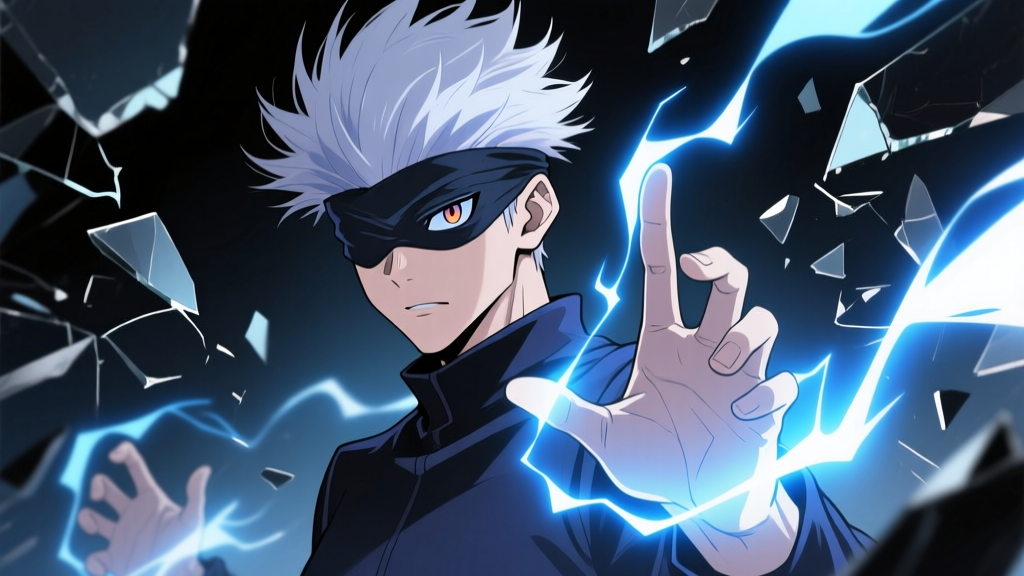
Gojo Satoru and the Paradox of Overpowered Characters Done Right
Gojo Satoru isn’t just strong—he’s narratively untouchable. Six Eyes. Limitless. A walking paradox: a character whose power level should collapse dramatic tension, yet somehow *deepens* it. In most shonen, an overpowered protagonist triggers diminishing returns—battles become rote, stakes feel manufactured, emotional investment wanes. But in Jujutsu Kaisen, Gojo doesn’t break the story. He *anchors* it. And that’s not accidental. It’s surgical storytelling.
The Power Ceiling Isn’t a Plot Device—It’s a Lens
Gojo’s abilities aren’t just flashy exposition dumps. They’re calibrated to expose thematic fault lines. His Limitless isn’t just “can’t be hit”—it’s a physical manifestation of existential distance. In Episode 23 (“Crisis”), when he effortlessly deflects Mahito’s cursed technique mid-sentence while sipping coffee, the camera holds on his sunglasses—not as a cool accessory, but as a barrier between perception and reality. We never see his eyes fully until the Shibuya Incident. That delay isn’t fan service; it’s narrative restraint. His power forces the story to ask: What does invincibility cost when everyone around you is mortal? When your students bleed, and you watch—*knowing* you could stop it, but choosing not to?
Jujutsu Kaisen doesn’t hide behind “power scaling.” It weaponizes asymmetry. Gojo’s strength makes every other character’s struggle more visceral. Yuji’s desperation during the Shinjuku battle isn’t diluted by Gojo’s absence—it’s *amplified* because we’ve seen what Gojo represents: the ceiling most jujutsu sorcerers will never reach. His power doesn’t erase stakes; it reframes them. Survival isn’t about matching Gojo—it’s about surviving *in his shadow*.
He’s Not the Protagonist—He’s the Compass
Gojo isn’t JJK’s main character. He’s its moral and tonal compass—and that distinction saves him from overpowered fatigue. His screen time is deliberately sparse. He appears in bursts: a chaotic classroom scene (Episode 3), a chillingly calm confrontation with Geto (Episode 13), a whispered warning before vanishing into Shibuya’s fog (Episode 22). Each appearance recalibrates the series’ emotional gravity.
His role isn’t to solve problems—it’s to *create* them. He recruits Yuji not out of altruism, but because he sees in him a mirror of his own past self: reckless, empathetic, dangerously unrefined. His mentorship isn’t about teaching technique—it’s about testing ideology. When he tells Megumi, “You don’t need my permission to be strong,” he’s not being cryptic. He’s handing off the burden of choice—the very thing his own power has insulated him from.
- In Episode 10, he lets Yuji nearly die fighting Hanami—not to “toughen him up,” but to force Yuji to confront the weight of his own decisions without a safety net.
- In Episode 14, his quiet disappointment after Megumi fails to protect Riko isn’t scolding—it’s grief disguised as detachment. He recognizes the moment Megumi begins to understand what it means to carry consequences.
- Even his infamous “I’m the strongest” line isn’t arrogance. It’s a confession. He says it like someone stating the weather—because he’s long since stopped believing it’s remarkable. It’s tragic, not boastful.
Emotional Complexity Hides in the Gaps
Gojo’s humanity isn’t in grand speeches or tearful breakdowns. It’s in micro-moments where his control slips: the half-second pause before he smiles at Yuji after learning about Rika’s death; the way his fingers tighten around his blindfold when discussing Suguru Geto; the exhaustion in his voice during the Shibuya flashbacks—not physical, but temporal, like he’s carrying decades of unresolved guilt.
We learn early he was once like Yuji: impulsive, emotionally raw, convinced love could fix everything. His friendship with Geto wasn’t just camaraderie—it was ideological symbiosis. Their split wasn’t about power. It was about whether compassion requires limits. Gojo chose to uphold the system, even as it failed people like Riko and Tsumiki. Geto chose annihilation. Gojo didn’t win that argument—he survived it. And survival, in JJK, is often the cruelest outcome.
That’s why his final moments in Shibuya land with such brutal weight. He doesn’t rage. He doesn’t beg. He *apologizes*—to Yuji, to Megumi, to the memory of Geto. His last act isn’t a display of power, but of surrender: removing his blindfold, finally seeing the world clearly, then letting go. His death isn’t a plot twist—it’s the logical endpoint of a man who spent his life holding back, not out of fear, but out of responsibility. The ultimate expression of his strength wasn’t Limitless—it was restraint.
The Narrative Payoff of Letting Him Lose
Gojo’s defeat isn’t a failure of writing—it’s the culmination of JJK’s core thesis: power without accountability is hollow. Sukuna’s dominance isn’t undermined by Gojo’s loss; it’s validated by it. The curse user doesn’t beat Gojo through brute force—he exploits Gojo’s greatest weakness: his belief in the possibility of redemption, even for people like himself.
Choso’s flashback (Episode 47) reveals how Gojo once saved him—not with overwhelming force, but by offering a name, a future, a chance. That same empathy becomes his vulnerability. When Pseudo-Geto manipulates Gojo into lowering his guard—not with a curse, but with the ghost of their shared history—it’s devastating because it’s *earned*. His power couldn’t shield him from grief. His intellect couldn’t outrun memory. His strength made him predictable to the one person who understood him best.
And that’s why Gojo works where so many overpowered characters don’t: he’s not defined by what he can do, but by what he refuses to do. He won’t kill children, even cursed ones. He won’t abandon students, even when they disappoint him. He won’t let his trauma justify cruelty—even when the world hands him every excuse to do so.
“I’m not trying to save the world. I’m trying to save *them*—one at a time.”
—Gojo, Episode 21 (subtitled version)
I remember watching that line and realizing: Gojo’s power isn’t limitless because of his technique. It’s limitless because his capacity for care operates on a scale the rest of the cast can’t comprehend—and shouldn’t have to. His strength is the narrative’s pressure valve, yes—but also its heartbeat. When he’s gone, the silence isn’t empty. It’s resonant. Because JJK taught us, across 24 episodes and two seasons, that Gojo Satoru wasn’t invincible. He was *present*. And presence—especially in a genre obsessed with escalation—is the rarest power of all.