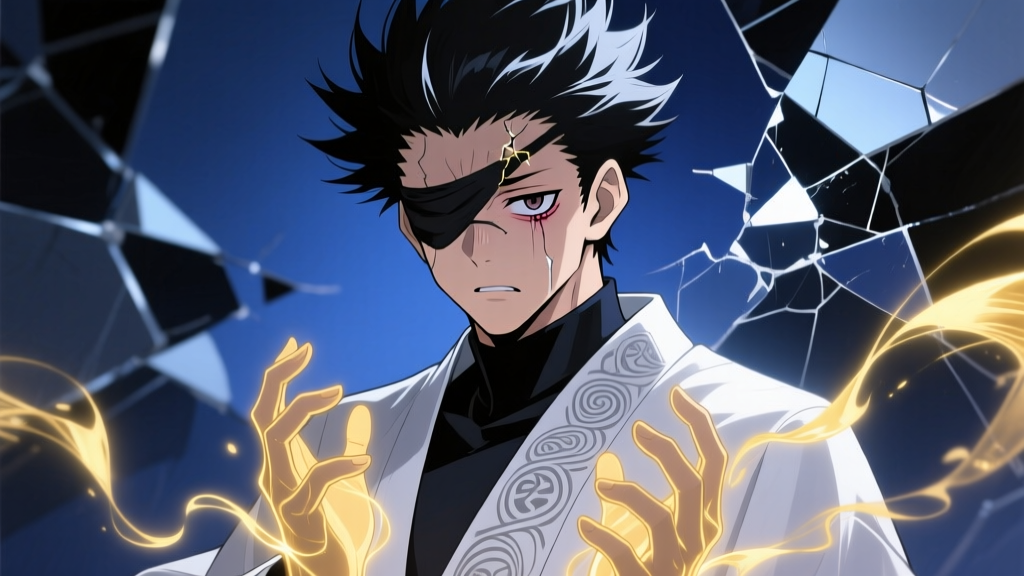
Gojo Satoru's Legacy: Analyzing the Strongest Sorcerer's Impact
By Kenji Park
Gojo Satoru’s Legacy: Not Just a Power Fantasy—It’s a Mirror
Let’s get something straight: Gojo Satoru isn’t *just* the strongest sorcerer. He’s the story’s beating heart, its most dangerous question mark, and—yes—the guy who made me cry in Episode 23 of *Jujutsu Kaisen* Season 2 while eating cold ramen at 2 a.m. His death wasn’t just plot shock value. It was the moment the entire series stopped pretending strength is neutral—and started asking, *What do you build with it?*
I’ve rewatched his first classroom appearance—Episode 1, when he floats into Tokyo Jujutsu High like he owns gravity—maybe seven times. Not because of the flashy Limitless or the blindfold (though that blindfold? Iconic). It’s because of how he *looks* at Yuji. Not as a vessel. Not as a liability. As *someone*. “You’re not cursed,” he says, voice light but eyes sharp as broken glass. That line lands differently every time I hear it—not as reassurance, but as defiance. Defiance against the system that labels kids before they breathe freely.
Gojo’s philosophy isn’t written in scrolls or lectures. It’s in the way he lets Megumi keep his shikigami even after failing the Shibuya test. In how he *doesn’t* stop Yuji from going to Shibuya—even though he knows exactly what’s waiting. In how he teaches Nobara to throw a hammer *before* teaching her domain expansion theory. His pedagogy is radical trust. Not because he’s careless (he’s calculated down to the nanosecond), but because he believes growth lives in consequence—not control.
That’s why his relationship with Yuji hits so hard. Gojo sees in him the version of himself he *refused* to become: the obedient weapon. Remember that flashback in Episode 22? Young Gojo, eyes wide and unblinking, watching Suguru Geto walk away from the Kyoto school—not out of malice, but disillusionment. Gojo doesn’t follow. He stays. And he builds something else: a classroom where students argue with him, question jujutsu orthodoxy, and—crucially—get to *choose* their own damn morals. Yuji’s “I’ll kill Sukuna” vow isn’t Gojo’s doctrine. It’s *Yuji’s*, forged in grief and love—and Gojo *honors* it. That’s not mentorship. That’s legacy-as-gift.
And then there’s Megumi. Oh, Megumi. Their dynamic is quiet, layered, almost painfully respectful. Gojo never calls Megumi “weak”—even when he’s stumbling through cursed technique basics. He sees Megumi’s burden (the Ten Shadows, the weight of his father’s sins) and responds not with pity, but precision: “You don’t need to be perfect. You need to be *present*.” That line echoes in Megumi’s fight against Mahito—not as a pep talk, but as a lifeline thrown across years. Gojo didn’t give Megumi power. He gave him permission to *trust his own instincts*, even when they hurt.
Nobara? She’s the one who calls him out—*“You’re not infallible, you know!”*—and he *laughs*. Not condescendingly. Not defensively. Like he’s been waiting for someone to say it. His strength isn’t armor. It’s an invitation—to challenge, to grow, to *matter*.
Which brings us to the brutal irony: Gojo’s overwhelming power is also his greatest vulnerability. Not physically—he *is* untouchable—but existentially. Because when you’re always the ceiling, no one can teach you how to fall. His final fight in Shibuya isn’t about losing. It’s about *choosing* to lose *on his terms*. Sukuna doesn’t beat Gojo. Gojo *lets* the fight end—not because he’s weak, but because he’s done performing invincibility for a world that’s forgotten how to protect its children. His last words to Yuji (“Don’t die”) aren’t a command. They’re the culmination of everything he stood for: responsibility without domination, care without control.
His strength was never just about Infinity or Hollow Purple. It was about *space*—the literal space he creates between danger and safety, yes, but also the metaphorical space he carves out for others to become themselves. He didn’t shield Yuji from pain. He made sure Yuji had the tools—and the dignity—to face it. That’s why his absence *hurts* so much in Season 2’s back half: it’s not just missing a powerhouse. It’s missing the person who believed in potential *before* it proved itself.
And let’s talk about that blindfold. It’s not a gimmick. It’s thematic armor. Gojo wears it *after* mastering Limitless—not to hide weakness, but to *refuse* the temptation of omniscience. When he removes it against Toji in Episode 10, it’s terrifying—not because he’s suddenly stronger, but because he’s *choosing* to see *everything*: the micro-tremor in Toji’s wrist, the shift in air pressure, the exact nanosecond his opponent blinks. That scene isn’t cool for spectacle’s sake. It’s a thesis statement: true strength isn’t seeing all—it’s *choosing what to see*, and more importantly, *what to ignore*.
His legacy isn’t in flashy techniques passed down (though Yuji *does* mimic his hand gesture before unleashing Cleave in Shibuya—chills). It’s in how his students now carry his questions: *What does protection cost? Who gets to decide what’s “necessary”? Can mercy be tactical?* Megumi’s refusal to kill civilians during the Shibuya arc? That’s Gojo’s ethics in motion. Yuji’s insistence on saving *everyone*, even Sukuna’s victims? That’s Gojo’s stubborn, inconvenient hope.
Even Geto’s tragedy is refracted through Gojo. Their friendship wasn’t broken by ideology alone—it fractured over *agency*. Geto saw cursed spirits as irredeemable; Gojo saw them as products of a broken system. One chose eradication. The other chose education—even when it meant risking everything. Their divergence isn’t good vs. evil. It’s two answers to the same unbearable question: *How do you protect the world without becoming the monster you fight?*
So when people say “Gojo’s dead, so the show’s over,” they’re missing the point entirely. His death *is* the story now. Every time Yuji hesitates before striking, every time Megumi chooses restraint over rage, every time Nobara refuses to dehumanize an enemy—they’re not filling his shoes. They’re walking paths he *cleared*, not commanded.
His strength was never about being unbeatable. It was about making unbeatability *irrelevant*. Because real power, Gojo taught us—through every smirk, every lesson, every silent nod—lives in the space between “I can” and “I *will*.” And in that space, he left behind not a throne… but a classroom.
Still haven’t forgiven Gege Akutami for that ending. But I *get* it now. Gojo didn’t leave us empty-handed. He left us with homework.
Kenji Park
Contributing writer at SenpaiSite — Your Ultimate Anime & Manga Guide.